
William Estrada Interview
[Brief Introduction]
Mohamed Mehdi: In 2016 at creating Justice you both presented about and set up the Mobile Street Art Cart. A lot of students interacted with you individually, making prints and learning about print-making. And your son participated with you in both of these, the presentation and in the print-making with the students. Can you tell us about the Mobile Street Art Cart? What is the project all about?
William Estrada: The Mobile Street Art Cart itself, the physical thing, is pretty new. It just turned 2 years old. How it came to be was that about 12 years ago I was asked by an organization in Little Village, a predominantly Mexican community, to do workshops. At the time I was a teaching artist at an elementary school and I had been curious, thinking about how could I do the work I was doing in the elementary school, talking about social justice issues, how to use art to address them, in the community. So they were like, “Would you mind doing some screen printing for us?” as part of the Little Village Art Festival that they were starting. I was like “Yeah, I want to do it, but I want to do it outside”. At first they were like, “It’s gonna be a bit chilly, it’s the beginning of the fall, why don’t you do it inside and we’ll leave the doors open?” And for me, I was having a really hard time. I was like, well if it’s inside any building, only people that know about it will go in. Or people who feel comfortable crossing that threshold will actually interact and be like, “Hey, what’s happening here?” And I was really interested in trying to figure out how to talk to people that weren’t going to go to that event, that may not feel comfortable opening the door and I would be out on the sidewalk saying, “Hey, do you have time to stop by and this is the thing that we’re talking about...” So we started doing these workshops, and it’s hard to convince people to do an activity, people are like, “How much does it cost?” “Well it’s free.” “No really, how much is it?” After they’ve actually done the project people will be like, “How much do I owe you?” And I’ll be like, “Nothing, for real, it’s free.” Or they’ll make something and then they’ll leave it and be like “Thank you. That was fun.” And I’ll say. “No, this is your work, take it.” There’s this idea that if you do something you have to pay for it.
So throughout the years I was doing these workshops. When I was in grad school, one of my instructors asked me, “If you had unlimited money, what would you want to do?” At the time, Chicago had passed a law making mobile vendors and paleteros have to get licenses, or they weren’t able to sell any street food out in the neighborhoods. And I started thinking about my memories of paleteros’ ice cream, ringing the bells, us running around, and our friends being happy, eating ice cream. But then I was also thinking about the people that sell the tamales and the fruit in the summer, and the fact that when I go back to Mexico I see those similar vendors, those similar foods. And the fact that this network of people are really preserving our culture by reminding us of the smells, by bringing people together that share histories or stories, and they're essentially building the community and sustaining it through these mobile spaces. So when they asked me, I was like, I want to build this cart that you see in the neighborhood but instead of selling food I want to build community through art, which is very much what I was trying to teach about in the schools and for the organizations I work for. So I started sketching things out, and I ended up getting funding from 3Arts through one of their project grants to do crowdfunding to build it. So I ended up hiring a carpenter to be able to build it and make it actually happen.
And I think it was the first time when I went out, people would hear the bells, they would be like, “I want a paleto de coco, I want a coconut, water or milk,” I was like, “I actually don’t sell coconut, I do like art workshops.” But I started getting really excited about the idea of people asking questions, “What is this for? Why do you do it?” Although the intention was for me to be able to engage with community members, and I was really excited about the project, I hadn't really thought about how much people were going to love it. People would come up to me and hug me, people would give me a dollar or change that they have because, they're like, “It's for materials, keep doing this, this is amazing." At some point I was like, “Yeah thank you for your contribution to this,” because it's something that they were walking through as they were going grocery shopping, or as they were going to do whatever they needed to do on the weekend or the day that I was there, and they stopped and experienced this. And they were like, “Oh, you should do this workshop next time, or you should talk about this issue next time.” And through that process I started developing workshops that would address that issue, or I would try and get the materials that people were interested in working with. Even though they might not get to experience it, they were essentially shaping the programming that was being delivered through the art cart.
MM: You were talking about the food carts, the paletero carts. All over the city they come through, ringing their bells, people flock to them...do you find that this connection or this echo helped you, that people would come because of the familiarity?
WE: Yeah it's not quite as I had imagined it. I remember at one time I was imagining me pushing the cart and people running [up to me]. That hasn't quite happened because I haven't pushed the cart through a neighborhood like that. I set up somewhere and then I try and get people. I see it more like the mobile vendors, the elotes, the chicharones, where they’re kind of stopping by. The art cart is more like those mobile vendors than like the paleteros.
MM: But the fact of it being a cart, and having that physical, cultural echo of the food carts of the various kinds, does that help to make people feel more comfortable in terms of approaching you?
WE: I think now that we’re several workshops into this, now some people will recognize me, “You’re that guy that does the workshops. What are you doing today?” Or other times people will mistake me for the elotero and they’ll ask me, “Can I get an elote, or an ice cream?” And I’ll tell them that’s not what I’m doing, this is what I’m doing. Or the paleteros or the mobile vendors will ask me, “Hey what are you selling?” And I’m like, “I’m actually not selling, I’m doing these workshops,” and they’re like “Oh that’s cool...but you have ice cream in there.” And I’m like, “No, I have art materials!”
MM: It’s interesting also the cultural echo of the carts here with Mexico, and other countries, the design of the carts creates this cultural familiarity so that you’re part of something that’s already there. It’s very new but it’s still connected to what’s going on. And you also want to draw people in together with your cart, just the way food carts draw people in, hanging around, waiting for the food, chatting…
WE: Yeah, having people be able to make these connections, meet each other. Also, a lot of the times what ends up happening is through these connections they’re like, “Where can I do this again?” And I tell them I might be here at this time. It’s also [a chance] for me to be able to get familiar with the organizations in the community that I’m working in to be able to say so and so is doing this program, they’re free too. And being able to make those connections has been one of the most exciting things. As an artist, as an educator, it forces me to have to figure out what’s happening in the neighborhood. Because people are asking me and I want to be able to tell them, you should go to this organization because they’re offering GED classes, ESL classes, they’re offering free art programs...because people will ask me, “I know you do art but we’re looking for classes on this. Do you know where I might be able to go?”
MM: One of the differences between you and the food carts is that the food cart is a commercial transaction. People know what they’re going for. You’re going to be paying this much, and this is what you’re going to be getting. But the art cart is free. How does that change the dynamic, because people don’t know what to expect, they can maybe be suspicious...so how does that affect the exchange?
WE: I think one thing is that it changes the relationship. It changes the power dynamics where it’s a shared collaboration instead of, depending on how you see it, either someone paying for goods that they can say, “I paid for this and I’m not satisfied so I want my money back…” or reverse of that, saying, “I am the expert and you’re paying me for this and this is what you’re going to get.” And I feel like the fact that it’s this transaction of labor and time shifts the notion of who has power in this, and it’s this shared collaboration and shared interaction. These are the things that we’re doing right now, how can you engage with them? These are the materials that we’re using, this is the art project that we’re going to be doing today. How is it relatable to the things you’re interested in talking about, that are going on in your life? And I think that’s made a huge shift because that also changes, as a brown male, I’m also a large male, it also changes the dynamics of the interactions that we’re told we should and shouldn’t have with strangers, especially in a bigger city. It challenges notions of who you should talk to and who you shouldn’t talk to. Who is safe to talk to, and who isn’t safe to talk to? For me too, as a father, having my children present, there are these challenging notions of what fathers do with their children. My wife is doing her thing while I am doing this with my children. And thinking about, why are your children with you, why are they not with your wife? Why are you taking care of them and not your wife? So we’re challenging these ideas of my interactions with my children but also my interactions with young women, young men, other men of color, through this art making. So I think the complexity and the different layers that are present in these interactions, there’s always this notion of challenging the structure of power and challenging the structure of cultural access through the art making that we’re making in this space with the Mobile Street Art Cart.
MM: What forms of art do you provide with the art cart?
WE: Screen-printing posters, and t-shirts, we do a lot of buttons as well. We’ve done birdhouses in the past to talk about migration, and how birds gather different small materials to make a nest, we do stickers, tin ornaments, and sugar skulls for Day of the Dead. Those are the workshops we’ve done so far, in these last two years. Partially it’s about accessibility and things that can be finished in a short amount of time, and sometimes also cost. Trying to figure out how many can you potentially make to distribute or mass produce with a community, and that also have a connection to organizing or activism, or the object has a connection to culture or remembrance of culture, or family stories.
MM: Making the buttons, and screen-printing, for example, have a lot of resonance in activist organizing and I wanted to ask you about printing in particular. Can you describe what it involves, and why it’s been so important for activist culture, for protest culture.
WE: The beautiful thing about screen printing is that you can mass produce, it’s really cheap, and depending on the complexity of the design it can be done pretty fast. It’s been used for centuries, since the invention of print. One of things that I’m particularly interested in, is the fact that when people see the screen printing they are very interested both in its commercial use and also how it’s used in organizing and in their communities. They’ve seen posters, they’ve seen t-shirts, and I always make that connection. If they ask, “Well what is this?” and I can say, “Well see your shirt? That’s actually a screen printing process”. Then I tell them about the layers. The screen printing that I do is a photo emulsion. I coat the screens with a light sensitive chemical, then I expose a black and white image or a contrast image to make the actual design itself. And usually the screen prints are either in response to something that’s happening in a community, or to something that a community member has mentioned in the workshop that we should be addressing. So I have an ongoing list of themes that people have talked to me about, that [they say] we should talk about, and I’ll burn a screen then go out and print posters, or print on t-shirts.And then if it’s on posters people will personalize it somehow either by adding some context or text to it to give context to the issue. Or if it’s t-shirts, we ended up doing two designs. One for Little ViIllage said “Little Village Love” and that was in response to a couple of women that were talking about how they’ve seen the neighborhood change, and the constant narrative they hear about the community, both Little Village and North Lawndale, was that Little Village is a bad place. And hearing all the things that are happening through the media, but lacking the complexity of all the amazing things that are happening there. Her response was like, “I love Little Village.” So we ended up doing a design that said “Little Village Love.” And the same, very similar, story in North Lawndale. When we were talking to residents in North Lawndale, they were talking about how there was so much pride in the community, North Lawndale’s presence within the civil rights movement, when Martin Luther King came to Chicago, and all the organizing that’s been happening for decades in North Lawndale. For North Lawndale the t-shirt said “North Lawndale Pride.” It’s so weird. It’s a simple t-shirt but there’s so much meaning and love for it. Still to this day, these have been designed last year, but still to this day, people will ask me, “When are you going to print more? I want that! Because I am from North Lawndale. I may not live there anymore but I’m from there, that’s my home.” And also from residents in North Lawndale, “We want that, this is our community, we’re proud of the work that we do here.” The same thing with Little Village, “I am a product of this community and I love it, for all the amazing things that happen and for all its imperfections as well.”
It’s this weird thing that’s happened too, specifically with the t-shirts and posters, and I’ve been training on tote bags too, you know, “North Lawndale Pride,” “I am North Lawndale,” or Little Village and one thing that’s happened is people will see those tote bags and be like, “You did those at the mobile street art cart? You know William?” They’re finding ways to connect on these projects that in all honesty, I had not thought about. They’ll tell me, “I was at the grocery store and I saw someone with a tote bag and I went up to them and I’m like “hey, I have a tote bag too!” And they’ll share stories about their experiences making them, which to me is beyond what I could have imagined of an impact, if you can call it an impact, people being able to identify each other through these workshops that have taken place in separate times and separate spaces but there’s this connection now.
MM: With those particular designs, the “Little Village Love” and the “North Lawndale Pride” images, can you say a little more about why it’s important in those communities in particular to express that love or that pride.
WE: I think for years there’s been this disinvestment in these communities and when there is investment it’s not necessarily for the community members that live there now. Because both communities are right now being slowly gentrified. But both communities are marginalized communities, they’re communities of color where there’s a lot of things present that the media focuses on, and it doesn’t necessarily focus on the amazing things that are happening there. There’s crime, there’s drugs, abuse of narcotics, but there’s mainly a disinvestment in health and schools. Schools have been closing down like crazy in North Lawndale and Little Village and I think part of that thing is that there’s all these...you know when someone is constantly talking to you as a person or as a community and saying all the bad things that are happening in your family, in your neighborhood, you start believing some of that. I think the act of having a North Lawndale Pride or Little Village Love, there’s this sense of pride that comes with that and a reminder of, you know what, there are other narratives that aren’t being told and the problems that we’re experiencing, they’re problems that have been created by policy. They’re problems that have been created by the constant disinvestment in our communities, and you know there’s self-medication because there’s lack of health care and lack of services present in my community. So I think it brings light to a bigger structural problem that’s systemic and the foundation of that is racism. I think it’s through these t-shirts and these buttons that we’re reclaiming our narratives of who we are and what exists already in our communities, and I think that’s a big part of why people get excited and people want these shirts, people want to experience these things. Because there isn’t a Little Village Love t-shirt that other organizations sell. There isn’t a North Lawndale Pride t-shirt. It’s not there, so they’re like I want that because I am proud of my neighborhood.
MM: You’re describing these really deep systemic, structural problems that are the causes of disinvestment in communities, of poverty, of abuse, and a lot of the things that we want to struggle against. When you dig under the surface and you see the depth of some of these structural issues, their complexity and how they are intertwined with each other. And I’m also struck that a lot of the work you do is really putting ideas out in a very simple way. So you’ll have an idea like “culture means…” or “justice means…” and let people think about what it means. I wanted to ask you about the simplicity of representation, whether it’s text or image, or a combination of those things. How do you keep the connection between that simple image, that simple statement, and the complexity of the issues that you are referring to?
WE: That’s a hard one!
MM: In the process of production, are those conversations taking place, and what’s your role in facilitating those conversations?
WE: The design is purely text. There’s hardly ever any images, it’s just text. I think sometimes images can be elusive, although text can be elusive as well, it’s a little harder. I think the thing that I try to think about when developing these designs with text is I try and be as direct as possible but there’s also room. If people are interested in engaging in the complexity of what justice means, then we can. But some people don’t, and that’s okay too. It’s those designs that make it accessible. For North Lawndale pride, we didn’t talk about the fact that there is pride or the fact that there isn’t and why there is or isn’t, why that particular community, being a black community, why there’s disinvestment and how we feel about it. We can take another design that we created, was one that said “I am North Lawndale” and thinking about the fact that it’s people that make a community, not the buildings not the streets, not anything else, but there’s these individual stories and there’s a complexity of those stories. Some more interesting than others, some more challenging than others, but it’s all those experiences that make the community what it is.
I think part of that is that the discussions can become very rich when people are sharing their stories of why this work is important. There’s also been times when people are like, “This is problematic. This tote bag is not going to solve anything.” And it’s absolutely right, the work itself is not meant to solve anything. But it is meant to ask questions and it is meant to connect people who might be interested in addressing these issues to say, “Why don’t we have more things that talk about pride,” or “Why is our community being represented in such a negative light all the time? Who’s making these decisions and what is the purpose of disinvesting in a community? For who?” The designs are meant to simplify these things by saying “Justice Means…” or “North Lawndale Pride,” or “Little Village Love,” but they’re also meant to start conversations to figure out, what does this mean? All the designs have come from conversations, which I think is the richest part of engaging in the community with the Street Art Cart as an artist, is that those conversations wouldn’t happen without the art making and without the cart in the street. And it’s through those discussions that we start thinking about the complexity of the issues that we’re attempting to address and how we might be able to ask a question, or what are some of the common narratives we can develop. I would say ninety percent of the designs have come from those discussions and then trying to break it down to something that can be screen printed and distributed.
MM: One thing you were doing at Oakton and elsewhere too, you would have just the word, and then people would respond to it, and write something. You were part of the 96 Acres project and one of the parts of this was the photo booth, Portraits of Resolution. So in that too you had people write down something on a blackboard as a backdrop for their portrait. Those were people’s own thoughts, but did you give them a prompt?
WE: Usually there are prompts. What is justice for you, is there justice? But for the Portraits of Resolution it was just, “How does incarceration affect you, your family or your community?” and then people responded. I think part of it too is, and I’ve had this conversation with other artists that are curious about how I develop these prompts, I have my own ideas about what we should or shouldn’t do. My role when I’m doing the Street Art Cart or Portraits of Resolution, is not to say, “No, we shouldn’t have more police,” or “We shouldn’t have more prisons.” My role is to talk to community members and learn how they think about these issues, not to attempt to educate them because I think my beliefs are right or better than theirs. It’s about learning and learning why they think about the things they do, not whether I agree with them or not. Ultimately that’s the power of these projects. It’s about engaging community members individually and not necessarily saying, “Mohamed, you shouldn’t think that”, or “That’s amazing, you should keep thinking that”. It’s about really understanding how they came to the conclusion that they have about that particular thing. For Portraits of Resolution what they ended up doing was responding to the prompt by writing on the chalkboard and then we photographed them against the backdrop that was their response.
MM: When you’re doing that kind of engagement, first of all with the Art Cart because there you’re really engaging with what people are making, you see yourself as helping them with the process of making it but not necessarily guiding them towards a conclusion. You’re opening up a question and saying let’s build this together and in the process of making that thing together you’re having all kinds of conversations where you’re just part of the conversation. You aren’t a facilitator or a teacher. You’re just helping them with the materials. And with the Portraits of Resolution you were creating portraits of people that were really beautiful portraits, portraits of people with their babies or just people with friends or just individual people, and then did they leave with a picture of themselves after?
WE: For the portraits, people always leave with an image then I have a form that most people fill out, not everyone, but most people fill out that asks if they want to be part of my website or if they would be interested in their picture being part of an exhibit in the future.
MM: Why the portraits, what’s the value of the Family Portraits?
WE: I think that particular project stemmed from my own experience growing up. We were not able to afford portraits and then as time has passed, thinking about the significance of portraits, being able to identify as a father, oh, those are my cousins who you’ve never met, but there’s this document that shows historical portions of my life that my children don’t get to experience or they don’t get to meet these people for the various reasons that exist but there’s this personal archive of who our family is. So the family portraits project, the Portraits of Resolution project stemmed from being able to document that, being able to identify who we consider family, whether it’s biological or chosen family, but it’s also a way of asking who gets to claim a community and for what purpose, whose stories are told and whose aren’t. Because now there’s these photographs of people from this community that they have in their hands, that I have as well, so there’s this shift, of my story is present through this document and through the stories that we have. Even right now, earlier today, I was actually meeting with ABLA residents here at the Jane Addams [Family Resource] Center, here at Loomis and 14th because I’m working with the National Public Housing Museum, and we’re going to be photographing as part of one of their events for Christmas. And although we’re really interested in figuring out what stories are present as this community’s changing as well, it’s shifting, what ends up happening to people? And we’re looking at the family portrait as a way to think about the resilience that exists already in our families, in being present and having each other. And I think a big part of that work is about that, we’re present, we are here, and our stories matter.
MM: In all these projects, the portraits, the printing, you’re taking the art into people’s communities. They didn’t begin the day saying we’re going to get our portrait done, you’re inserting yourself in there. Would you see yourself as bringing out something which is just waiting for expression?
WE: I would frame it differently. I would frame it as it exists already, I’m just documenting it. I think it’s present there, it exists, people are doing it already. It just so happens that through the projects I’m working with, I’m documenting it. And then through the stories I’m telling, I’m just highlighting it again. But I think all this creativity, all this work, the consciousness, all the political power is already there. I’m just engaging in it. I’m present and I’ll be like “Hey what are you doing about this?” And they’re like, “We’re organizing, we’re really mad.” Because I think sometimes those conversations are not really happening in a public platform. But they’re happening at the schools with other parents, at the kitchen tables, at family gatherings, all those conversations are happening, they’re not happening at the rallies, or they may not be having these conversations at the rallies or protests but they’re happening when they’re having coffee, when they’re making breakfast, when they’re getting together with their friends.
MM: What does the art add, the creating process, the making process, beyond the documentation. What else does the process of making beauty add to those conversations?
WE: I think the art itself is a reminder for people that it’s a way to disseminate their stories, to address their concerns. And a lot of the work that I’m interested in doing is reframing what art is. I think art as a luxury is great, and I can appreciate it sometimes, it’s very beautiful to look at. But I can’t afford that luxury. Art for me is about survival and sustenance, and I try and remind that art work is radical, it’s powerful and it has brought governments down, and it’s a way for us to do that. I remind people that art has that power, and as a people it’s one of the most amazing tools. We’re told to forget about it, that we should just look at art as art, but it’s a way for us to amplify our voice. It’s a small reminder that you have these things to say, this is a platform that you can use to amplify that message.
MM: Do you think that that power, in the work you do in communities, is that power intensified by the directness and the simplicity of a verbal expression, a phrase, that it’s focused on? What is empowering about those phrases?
WE: One thing is that knowing that a simple phrase can be turned into a powerful phrase. It’s also the fact that people are coming together and discussing these phrases in a larger context of themselves, their families, their communities. It’s this sense of I have this concern, it’s something that I’ve been thinking about, and you’re telling me that all these other people have been thinking about these same things? Knowing that you’re not alone, that you’re part of this community of public intellectuals that are addressing these issues. I think that’s where the power comes from. You know you’re concerned about it, you know other people are concerned about it, but knowing that you have this tool to disseminate it and amplify it. There comes this realization that I can do this.
MM: Your work is always participatory, local, very involved in the community. Partly it’s having an impact, an effect on the places you’re taking it, but it must also be having an effect on you, to be in those places and in those communities and those conversations. Can you tell us about what impact it’s had on you? First, in terms of your relation to the communities in which you’ve been working?
WE: It’s been humbling. I think sometimes with the work our egos get overinflated and having the discussions and doing this work in the community it reminds me to be humble. People don’t care about where I teach, what I’m teaching. They care about whether I’m treating them with respect, whether I’m really listening to them, really listening or just agreeing, and whether I’m going to be there when I say I’m going to be there. It’s a constant reminder for me that whatever I’m doing, wherever I’m working, ultimately it’s about the relationships and being respectful, being able to listen, being able to talk to people and not being in my head, thinking about how I’m going to respond to them but being present with them. I think that’s been the biggest part that I’ve learned about this work.
MM: How about in terms of your ideas about the role of art in fighting for social change? How has that changed through this process of talking to people, creating with them?
WE: It’s complicated. When I first started doing this work, I was like, we’re going to solve the problems of through this one art work, through this one project, and I’ve realized that that’s not going to happen. I am not going to solve all the problems. What I will be doing is engaging in discussion about how art can be used to amplify, or how are we going to pose a question to people who might not be thinking about it, or how are we going to invite people to the discussion because they’re also having the discussions. Small actions can have big impacts, but you need to be present and you need to be doing the work.
MM: If someone said to you, “I want to give you all this funding and I want you to make ten more Art Carts and take these into all these communities and do it in all these different places,” how would you respond to that suggestion?
WE: That sounds amazing, but I don’t know if I personally would want to do that. Because then it becomes about managing these ten carts and developing programming for them. That would be great for the people for the communities where they aren’t getting that programming. But I feel that that loses something and I’m personally not ready for that yet. I like the fact that I’m heavily involved in the process, I get to share in the conversations, and I would say to that individual or organization, if you really want to support this work, give me the money to just let me do it. Or have other people that are doing similar work and fund those projects.
MM: The involvement in this project, those personal connections and conversations, to you, it sounds like, that’s more part of the “success” than its expansion into something bigger.
WE: It depends on how we’re defining success. Is successful having a global street art cart fleet that is in every corner, there’s one in every major city, is that successful? I don’t know. Potentially it could be chaotic and problematic too. What is success, and for who? Is it successful for me because I have these carts all over? But what is my connection to a rural community in China? What is my personal connection to that community, and how is my idea of programming going to benefit them? I don’t think it will, because I don’t know that community. And that’s what’s lost. The problem is when we think one thing is going to be applicable to everyone, because it might not be. It becomes forced. It has to work here because it’s worked everywhere else. You’re doing something wrong.
MM: Going back to what you said about small actions make a difference, but that difference may be evident in very different ways than in expansion, something that you can count in numbers. You’ve taught in elementary schools, and your son has been at your side with the art cart, and many of the people you’ve worked with with the art cart have been young people. Why do you think it’s important for young people to approach issues around social justice through art?
WE: One reason is that art sometimes is portrayed as magical thing that you either have it or you don’t, or that it happens in these dreams and then you wake up and make it. With these interactions, I try and reframe that. Art-making is work, it’s labor, it’s not always easy. There’s a process that you’re part of as researchers, as intellectuals, I think that’s a big part. And how we can use art to tell stories, and how there’s power in making. The other thing is that as a male, who grew up in communities very similar to the ones I teach in, being able to say I have my bachelor’s, I got my master’s, these are the places that I teach. To bring something like that with me, being an artist, being an art teacher, and saying this is a path, if you so choose, you can be part of. The other thing is being a brown male and doing this work in public and thinking about how males can interact with each other and with other youth. I like laughing, I try not to be pretentious, and we have these discussions, laughing with others, sharing stories, and even for my children that are both males, even thinking about their relationship with the community, their responsibilities, and how they should and shouldn’t talk to women and men. It’s mutual respect and I really try to model that through my interactions. And if I am getting frustrated to say, “I’m getting frustrated let me take a step back and chill.” I think that’s a big part of the interaction. I work as an art teacher, as an educator in elementary schools and other arts organizations but these dynamics change when you’re out in public. Although I’m teaching or facilitating something, I’m not necessarily a teacher all the time.
MM: You don’t have that position of established authority, you have to do what Mr. Estrada says!
WE: And I tell people, this is what we’re doing with this but there’s no way of me controlling it. You can take it or leave it. You can say I’m going to engage with this issue you’re talking about. Or no, I’m gonna make whatever I want. And they can.
MM: So the process of creating really allows you to delve into social relationships and try to figure out how to engage in those relationships and to model that.
WE: And it changes, it changes based on whatever everyone brings to that moment. I know last year in the end of October I was doing a sugar skull workshop in Little Village. We had a lot of people doing sugar skulls that day, it was a little chaotic. But I remember this young man came up to me and was like hey what are you guys doing. And I told him about the sugar skulls and we started talking about Day of the Dead and as we were talking about this he was like, can I make one. And I was like, of course, and he was making one. And he must have made six sugar skulls. And usually I tell people you can only make one. He was like, “Man this is amazing!” He made two sugar skulls and then took them home and then he came back and made another four. And as he was doing the work, he was like, “Why are you so nice? You don’t know me, and you’re so nice.” Sometimes we forget we’re constantly told that we shouldn’t teach strangers with respect because they could be dangerous so we forget and he told me, “I was having a really bad day. There’s so much stuff happening in my life and I could just forget about it and do this work here, Thank you. Because I know I was only supposed to do one and you let me do as many as I wanted.” There was no other intention other than I saw him enjoying it. When the sugar skulls are finished, they’re finished. That’s what they’re here for. I’m not charging for them, they’re free. That was a moment, and I could’ve been frustrated, but that’s not the point. When he finished, and he was like, “Thank you, I know I have to go deal with other stuff that’s happening, this moment gave me a little bit of tranquility.” And he hugged me and I said thank you, that’s really powerful.
MM: That emotional level really is powerful. What about with the issues you guys are creating around? If you’re working around incarceration or some other event in a particular community, a response to violence, and when you’re having people come and create in the moment who you don’t necessarily know, is there an emotional dimension attached, with people expressing how they feel about these issues, that can be very intense at times?
WE: Yes, definitely. It’s happened with the art making itself. I’ll give you three examples. Two are for the art cart, one is for the Portraits of Resolution. For the art cart, people will get really excited about sharing their political views, and saying, “I’m really tired of number 45 saying this,” or, “I’m tired of my community or people in my community being attacked for this.” Or I’ve also had experiences where people are like, “I’m a Republican,” or “I’m an Evangelist, you’re not going to want to hear what I have to say.” But I actually do want to hear what you have to say. Whatever you want to say. My job is not to censor you. So if you want to make something, make it. It’s not about, I’m only going to support this and not that. When people have made work like that they’re like, thanks, I was not expecting that, but thank you for letting me participate. And we’ll engage in a discussion about that, we don’t have to agree but there can still be some mutual respect. And then for the Portraits of Resolution, part of the Portraits project, the intention was to do audio and to capture people’s stories. But people were in such a vulnerable state that they were sharing a lot with us. Powerful, sometimes very painful, things.
MM: And this was right outside the Cook County Jail.
WE: Yes, complete strangers. We didn’t know them. The space was so...there was a lot of power present, there was a lot of energy. People would hug us and cry in our arms. We would start tearing up just feeling that. Other people would be like, “Why are you doing this? This is so ghetto, who would want a picture of what’s happening now in their lives? You need to leave.” There’s definitely a lot of moments where people were hugging us, crying and thanking us, thank you for acknowledging us and our presence and the fact of what this building, this system, has on us. And other people were like, “Why would anybody want to remember?” Which, again, all of that is powerful, and all of it comes from a place of thoughtfulness and our own troubles dealing with these issues. For the Portraits of Resolution, we knew people were going to be wondering why we were photographing, who we were working, but we were not expecting the level of intensity of the story telling, to the point where we just can’t record these stories. As powerful as they are, people are in such a vulnerable state it almost felt like we were taking advantage. If they want to share them, we can contact them later but right now let’s just be here, let’s listen. If they want their photograph we’ll photograph them, and if not we’ll just listen. There were times when we would just listen, we wouldn’t even photograph. People would go into the building and they would come back and they would…There were a lot of moments where it was like “that was amazing,” and a lot of moments where it was hard.
MM: Maria was talking about this too, the healing aspects that people don’t think about in relation to art and social justice. We think about it in terms of strength and fighting and power, but not often in terms of a necessary healing and therapeutic process.
WE: For us, it was Anthony Rea, Erica Brooks, and myself. I think the three of us, we weren’t sure what to expect. One thing that the three of us realized was that it hurt. People were crying and we would be hurting. Even though it wasn’t out pain. We were talking about this idea of how these systems that we’re working under and against, there is this collective healing that we’re taking part in. And even bringing up our own pain and hurt through these discussions. Again, it’s very much about the relationships, being present, and knowing we were there and we wanted to hear what they had to say. In a lot of projects that’s what makes it really powerful.
Maria Gaspar Interview
Mohamed Mehdi: Can you begin by telling us about what the 96 Acres project encompassed? It had a lot of components, so how would you describe the overall project?
Maria Gaspar: 96 Acres is a project that focuses on the impact of incarceration particularly on communities of color at the Cook County Jail. We use public art interventions, we’ve used the term “site-responsive,” to put a flashlight to that site and think about the political, social, cultural implications of it on Cook County, on the city, and on our communities.
MM: For those who may not live in Chicago, and may not be familiar, can you tell us about Cook County Jail and its significance?
MG: Cook County Jail is the largest single site pre-detention facility in the country, as opposed to other counties where there are maybe many county jails, this is the only county jail in Cook County. There have been varying numbers over the years but a couple of years ago there were about ten thousand people locked up inside of Cook County Jail. I just heard a different number a couple of weeks ago, which had it under seven thousand. One of the reasons may be that electronic monitoring is being used more and more, which is a whole other conversation. But it’s unique in terms of the scale. It’s 96 acres in size, which is about 74 American football fields. It’s within a neighborhood of 80,000 residents called Little Village, La Villita, on the West side of Chicago and the majority of people are black and brown people. Which is not unique, actually, that’s the national racial disparity that is across the country.
MM: In terms of the communities where these institutions are built?
MG: I can’t say for sure but what I mean is that most of the folks locked up are Black and Brown people so that is not a unique situation.
MM: What about Little Village as a site around these 96 acres, can you give us just a little bit of background on that community?
MG: Little Village is now a predominantly Mexican, Mexican-American Community, it’s an immigrant community. There are a lot of entrepreneurs in that neighborhood, a lot of shops down a main street called 26th street. Things like dollar stores, to bakeries, to dry cleaners, to CD shops, things like this. Quinceañera shops are very common. It’s different from Pilsen. They get compared a lot and they’re right next to each other, which is one of the reasons that they’re both ports for Mexican immigrants. But it’s quite different, it doesn’t share the same kind of art and cultural history as Pilsen. But it was the home of Chuy Garcia, who still lives there, who ran against Rahm Emmanuel a couple of years ago, it’s a neighborhood that has a long history of activism as well. They built a recent high school called Little Village North Lawndale high school that was fought for by parents and hunger strikers. It’s a very vibrant neighborhood. There’s a lot of color, a lot of murals, it’s very active.
MM: When you were developing these projects in that neighborhood, not everyone was from there. You brought in artists from all over the city and you worked with groups and organizations, some who were from Little Village and some who were from other parts of Chicago. Could you name a few of the organizations and artists you worked with on the project?
MG: When the conversations got started the organizations at the table were Enlace Chicago, which used to be called Little Village Community Development Corporation, who I’d been working with for a long time, super-supportive of the arts, and doing great work in the neighborhood. And then the other organization is Chicago Public Art Group, which is known for their public art work over the last fifty years or so, since the 1970s, so for a long time. At the table were some political officials from the area. Enlace and I pitched the idea to a couple of people like [Cook County Commissioner] Chuy Garcia, and after that Chuy Garcia put together a meeting for us with [Cook County Board President] Toni Preckwinkle’s office, the sheriff’s department, and local aldermen, and that kind of started off a lot of conversations. And then we held community meetings, big picture community meetings at places like Chicago Public Art Group and other places, in Little Village in particular because Enlace was there, the Jail is there, I’m from there, [as were] many of the people that were a part of it, so there was a tendency of meeting in Little Village a lot. Elena Quintana from the Adler School of Psychology was and continues to be a really important person who helps us think through some of the political and psychological, emotional parts of the project and the impact that we could have on communities, but also how to engage people on the inside of the Jail.
So there were eight artist projects that were [part of it], and we got funding, and then we re-granted through a community process. There was a steering committee, and there was also a panel that was separate that determined who would get the funding. I did sort of the first cut and then they did the final. So the artists were people in Chicago, like William Estrada, Anthony Reya, and Erica Brooks, who had already been doing a lot of awesome community work. And then another architect / artist came from New York named Landon Brown, who did Park, and it was the re-broadcast of B.B. King’s concert at Cook County Jail and then other audio that we had recorded. And every project then kind of gathered other artists. Park, for example, we invited Jacqueline Serrato, who is a journalist now I think with the Tribune or Hoy, she contributed audio and she was doing recordings on site. Another project that we did was the Visible Voices Ensemble with Bobby Biedrzycki from the [Goodman Theater]. This was a group of women who were formerly incarcerated who were doing theater and they stationed their theater piece in front of the Cook County Courthouse and right on the side of the visitor entrance and it was on a Saturday, so there were many families walking through who then would participate in that project.
The steering committee members included artists and also non-artists, people who maybe are doing social justice work already, or teachers, lots of teachers, so Paulina Camacho out of Benito Juarez, Sylvia Gonzalez, who is now an independent art educator, so there were artists and educators and there were others like Michael De Anda Muñiz, he comes from sociology, does some photography and does a lot of social justice work. So a pretty wide range. Michael Johnson, or MJ, is interested in urban design, urban planning, but through a community engagement process. It brought to the table a pretty nice wide range of folks.
MM: The issue of mass incarceration that you were tackling with this project is something that there has been a lot of organizing and research around, and there are different ways of approaching it both in terms of organizing strategies and in terms of thinking about it as an institution in our time. In figuring out what your focus would be, did you begin with something about Cook County Jail and the community around it that would then speak to the issue of mass incarceration more generally, or was this an issue that you wanted to work on and then Cook County became a place for you to think through the issues? How did the general issue and the specific site interact in the development of your approach?
MG: I can speak to my own individual experience. I’m an artist, and I’m also an educator, and then I’ve also done a lot of organizing around arts and culture in Little Village. So as an artist and as an educator and somebody who grew up a few blocks away, I think the jail was always in my consciousness, whether I knew it or not. I have a family that comes from some activism, I also have family, who one of them is a cop, and we’ve got educators who work in schools there. So I think for me, I’ve always thought about the importance and value of what it means to live within a neighborhood that has these places of thriving, places that people thrive in. Community centers, the Boys and Girls Club, my mom did a bunch of work at the Boys and Girls Club a few blocks from our house. These are places that people thrive with their organizing, they are creating these really beautiful DIY spaces that are interesting and artistic and creative, but also really responding to the needs of the community. And when I was working on a project called City as Site in particular, and I was walking through the neighborhood with the youth and we were doing these performances in the neighborhood, we came across what we started to call the largest architecture of our neighborhood, which is the Cook County Jail. We had had a lot of conversations about where we feel safe, where we feel unsafe, and mind you, I’m working with Black and Brown youth from Lawndale. As we walked together we also talked about how people responded to us walking together, the politics of walking, the politics of space, and as we were looking at that, I started to really think about my public art practice, my work in the neighborhood, and what would it mean to do an arts and culture project at that site.
And that's kind of how it started off. I guess you can say I came with life experience about mass incarceration. I went there when I was 12 because of a Scared Straight program. I have run into my students at Juvenile Detention. I run into old family friends at Statesville prison. It's part of the world that I live in, unfortunately, and so it was really like, what does it mean to do a project here? And what are the sort of aesthetic implications, what are the political implications of this, and what would it mean for artists and cultural workers to do work here? That's how it started and then we would just sort of gather people together and say we want to do a project here, what do you think? In a way it was testing the waters, so we invited local muralists and artists and organizers to come to the table. People threw out ideas: murals, we talked about projections, we talked about doing programming inside with detainees, we talked about some people in the neighborhood feeling like the east corridor of the neighborhood is blighted, so can art make it look better? Things like this.
What happened over time is that you can’t talk about a place like this without talking about what it means, it’s a brutal, traumatic place, and everybody that associated themselves with it understood that. Bad things happen there. Most people knew somebody who spent time there at some point, or they spent time there, so I think that we associated that with trauma and brutality, so through those discussions we started to unfold ideas about mass incarceration. People talked about prison abolition, people talked about education, the school to prison pipeline, so it started to just unfold these larger conversations. But I didn’t come with an agenda around mass incarceration, I had my own lived experience of that but it certainly wasn’t in a formal way. I had to really school myself on it, and people schooled me on it. Over time I started to learn about it, and started to really pay attention to folks that had been doing this work for a really long time. Mariame Kaba, of course, who I think is an inspiration for many of us, I remember hearing her say, there is no choir to preach to around mass incarceration because it is such a monster, and it’s something that we don’t fully understand yet. So never think that there is a choir to preach to. That has always stuck with me for many reasons, because it just demonstrates the fact that it’s such a deeply rooted systemic problem that leads to a tunnel of issues. And when you start to really follow the trail, you have to start to reflect on economy, and poverty, and education, and racism, and all of those things. It just keeps going. So I think that it really came over time.
MM: One of the things that was unique about the 96 Acres project is that you’re looking at its impact and its presence within a bigger community. One of the things you mentioned just now was that it was in your consciousness even though you didn’t always know it. It’s crazy that there is this immense structure, 96 acres, the biggest architecture in the area, that at the same time can be ignored and invisible. You move around it without really paying attention to its presence there. And part of what you were trying to do was to try to make something visible that isn’t visible in the normal sense. Can you say something about that process? Is there something transformative in the process of making visible, or is it revealing what was already there?
MG: First of all, early on, to give a little context, I did a storyteller’s workshop at Vocalo, which was really a way for me to do some research on my own, me, myself and I doing some research. I went around and I interviewed people who live in the area, friends of mine, people who grew up in the area, or random people I met, and just asked them different questions. But most of it was around, how does this site play a role in your life? And some people said these very interesting things, like, I grew up on 25th and Sacramento, and because I faced a particular direction, not towards the jail, I just didn’t see it. I met one young man who said, my father’s locked up right now so it’s actually very convenient for me to just visit him. I can just walk down the street. But then what does that mean, he’s right there, but not really. You have to access him at a certain time of day, there’s a glass in between you, you can’t touch, all of these things. And I was looking at the work of Avery Gordon, who talks about ghosts and hauntings, which I think is a fascinating subject when you’re talking about places and the way we experience different kinds of architecture and spaces, etc. But you know there is something, like the jail is a kind of ghost but the kind of presence, the permeation, the emotional qualities that it expels are deeply psychological, emotional, painful, painful for many people.
One guy whose father was a corrections officer for a long time, this guy’s an artist who I was interviewing, and he said he would pick up his father and he remembers smelling [it], he knew that the jail was near because he could smell it and he described the air as being different, just different in that area. I thought that was really interesting, the way that physiologically, places like this really affect our bodies in this way. Which to me really connects to conversations happening now around healing and trauma. That to me is such a clear connection. So part of what I’ve thought a lot about and many others have thought a lot about is, it’s such a hard space and it’s a space that has been normalized, which I think is the problem. It is a problem that we normalize places like prisons and jails because, as an artist, I think that’s not very creative. It’s not very imaginative to just settle on this on a political level, I’m also connecting it to that. Can we imagine another 96 acres? And people have answered that question in our project [by saying]it would be a park, for example.
I think it was important that the project doesn’t necessarily beautify. We didn’t want to put a beautiful picture on top of a harsh space to further normalize it. And we had conversations about that with community members, where people said can you just make it look nicer? Can we put pots in front of the jail, we have some, can we put some up? Can you almost, like, make it go away? And we had to really think about, what does that mean? So it’s an interesting question around aesthetics and I really love that question because we were digging really deep into things that people maybe don’t imagine happen on this sort of level. We were really grappling with this.
So anyway, I think of the space as a hard place, there’s edges, it’s cement, it’s hard, it’s rigid, it smells, all the different things. It’s a painful place. And I think that we were trying to put a flashlight to it, yes, reveal what’s there, but at the same time I like to use the word tender, to do it in a tender way that’s then about creating a compelling image, a compelling series of images, a compelling experience, where the viewer is brought in: look at this, but we’re not going to hold you to it forcibly. Because then we’re just doing the same sort of gestures, the way that people get arrested, the harsh gestures of that, but rather, how do we do it in a tender way so that we can hold you to that space but then you have to contend with it, and it’s going to be slow, maybe, that process. That’s what we were trying to do and I think a lot of the projects, if not all of them, do that. William talks about in his mobile photo studio, that he took pictures of people but there’s so much that was said that is not in the picture. The photograph to me is just one element of what he did there. He had long conversations with people. Some people would return to talk to him, some people cried with him. A lot of things happened there. When I think about the projections, where we showed the project by the Prison and Neighborhood Arts Project the men made these amazing images that they then animated. We showed a project by a local high school teacher and a couple of collaborators and they did an animation. To me the narratives and the images that were put up on this very hard surface were images that were hard and soft, and tender and strange, and all of those things. And so I think about the wall in a symbolic way, through metaphor, “how do we permeate it?” Not “let’s make it soft so that people can feel good about it,” that’s not what we want to do. How do we permeate it so we’re breaking through and building down, rather than up and hard, and that’s what it is. So I think each of those projects is doing that, both flashlight, but with a sense of tenderness so that we can bring people in.
MM: The idea that some may have of art that is politically oriented is that you want it to reveal something in all of its harshness, show the brutality so that people can be shocked and upset by it and want to do something. But you mentioned healing and trauma earlier, do you think this kind of art has a role to play in that process, of healing from trauma? And some of the emotions you discussed that people were sharing in different parts of the project, do those conversations play a role in the process of healing?
MG: I’ve thought about this a lot and this continues to be an internal conversation, and a conversation I have with others, something I’m paying attention to a lot. I think art is powerful, art is a cultural force. That is just so true. And I think it can have different kinds of echoing reverberations, these kinds of effects through movements, it can kind of push something. That’s what I love about it. That’s why I do it. I don’t know how far it can go. Every piece does something different, every piece might do something different to you than to another. But what I remember a lot is when we did the projections project and a woman and her daughter were passing by and we caught it in the video. She was generous enough to share her story with us, and she was very emotional. And she was telling us that her son was locked up and through this piece, it made her think about whether his daughter was going to feel this pain the way this woman was feeling her pain through this story we were telling, this narrative. And to me when I watched her speak it represented this opportunity for somebody to see their story in a very public way, in a very caring way, I hope, to see their story on this space, done in a very compelling way, and that did something for her. I don’t know if she felt healed by that, but I think that [for me] as a young Latina woman, first to go to college, first to leave the house before getting married, I think with all of those things that people of color go through, especially in immigrant families, it has meant a lot to me to see a person of color in an academic position, it means a lot to me to see myself in somebody else. So I think that when I watched her I thought there was a power in that and it made it feel like we were going in the right direction.
MM: For you, as someone who grew up in Little Village, working over a long period in the neighborhood on this project, you must have made new connections but also built on old connections. How was your relationship, or was your relationship, to the area and the neighborhood changed through this project?
MG: Yeah, it has, it has changed a lot. First of all there’s just a lot more, younger artists doing work in the neighborhood. One of my former students Josue, I think he’s just painting up the neighborhood, and they’re beautiful, they’re weird, they’re strange, they’re very mythological…
MM: And where can people see them?
MG: There’s one corner on 26th and Central Park that I see all the time that’s really quite beautiful, there’s another one on 26th street in K town and there’s others, I see them everywhere. Yollocali is there now, they used to be in Pilsen and sadly they had to leave that building but in one way it’s been really awesome for Little Village to have them because they’re producing some really contemporary work that is incorporating digital media, they’re just making weird art and I love it. I love that because I think Little Village has always had this potential because it doesn’t have that history of that deep arts and culture work, Casa Aztlan and these other places that were really important to Pilsen, and to Chicago, really. But Little Village was a different kind of platform for possibility, and what I love about it is there’s a full range. There’s people doing highly political work in a very public way, there’s others doing some weird art that’s really beautiful and radical, just as radical, and I think it shows its full range of artistic creative possibility. Historically, Enlace has played a really important role in that. They’re not the only organization, of course there’s many others, but I think that through their quality of life plan that I was involved with early on, they, with other community members, identified that arts and culture was one of the greatest voids in the neighborhood, there really wasn’t enough. And that was 2005. And then we started the Little Village Arts Fest and then over time now it’s in its 12th or 13th year, now it’s called Villarte Chicago, so it’s also really beautiful to see how something has continued to transform and change because it grows with fresher and newer people, and I think it should stay like that. So a lot has changed in the neighborhood, for the better. I’m excited to see what’s happening that’s fresh. I know a young woman who’s currently here at the Art Institute and she was a student of mine at City as Site and we were doing weird public art and now she’s doing this awesome project using public material and adding her twist to it. She was working at the Philly Art Mural program in Philly, learning from that. So it’s an exciting time, though it’s a complicated time. Because not only am I thinking about the ICE raids that are happening more and more, and Trump, and gentrification that has really impacted Pilsen a lot, now we’re starting to see how it’s seeping into Little Village just slightly, so people are really paying attention to that, so that’s a scary moment. But otherwise a lot has changed and a lot of it has really come from the neighbors themselves, which is what I really love to see.
MM: For you as a long-time artist and organizer, with this experience in Little Village, do you have the same kind of connection with this most recent work you’re doing in New Haven?
MG: I do now!
MM: How was that different, going into a place where you’re sort of fresh, versus working in a place where you have these very deep ties and commitments, and trying to do something similar, working with a community and around an institution, getting people’s stories, was it a different kind of challenge?
MG: I had a lot of apprehension about it because of everything you just listed. I come from an experience where I think deeply about what it means for folks to really identify the assets of their own neighborhood and then amplify them. I think a lot about that role and that process, how important that process is. So I definitely had a lot of apprehension about it. But the project really started two years ago. I was invited by an arts organization that’s been there for a really long time, I have a good friend who lives in the neighborhood where I was working who’s doing some powerful arts and culture work, so I started to kind of just team up and partner up with folks and went through the similar process of grassroots work, which is building relationships.
But I don’t live there. I was flying in every now and then and meeting people. But I have to say that people were very generous to me. Going to re-entry round tables, meeting people who are the folks at the table doing work around PIC, who are the people that are doing work in social justice issues, and over time I started to develop relationships with them, mainly some really amazing local people who are organizers and working in a very different city system. Here we have wards, there it’s called something different, it’s just split up differently. In New Haven they have something called community policing, which is super controversial and there are these community spaces that take place at these sub-stations, these community and police stations. It’s a very different kind of situation. So I had to really learn and meet people and just try to develop relationships with people who I felt had some insights that would be very important for me in terms of how to shape the project. And also trying to figure out, how can I contribute to what they’re doing? I think I always come with that idea, which is I don’t want to just sort of plop some art into your community, but how do I contribute to what you’re already doing?
So that was what I did. At the end, after our event debuted two weeks ago, people were asking me, when are you coming back? What now? And all of these things. Now I’m having conversations with the organization that invited me to do this, to really now think through these relationships that have developed. So how do you really take this next step and develop those relationships so that every year that same community engagement process can happen? There’s some strategic planning stuff that I didn’t think I’d be doing in a place like New Haven, because that’s not my community or my city but it taught me a lot of things about the role of artists, and the role of artists doing this community engagement work. Sometimes one has to be really careful, because there might be these other things you realize that are not on the table, that the organization has not worked on, so you have to help to mend some relationships or re-connect people. But it affirmed some things for me, that coming from Chicago and having worked deeply here, that I could take it to another place. And that was really affirming, that was really great to realize, some of those tools that I have learned in Chicago, that I could take some of those tools and they could be used in other places. But no place is monolithic, no place is the same, but at the end of the day you have to knock on some doors, hey neighbor, we’re doing this thing, what do you think? It does come down to that. That was something I realized.
MM: Which can be a daunting process, because you don’t know how people are going to respond, if they’re going to welcome you. With that process, it sounds like in some ways your experience organizing and working within a community informs how you connect with people for the sake of creation, for the sake of art. But the other way also, what is it from your experience working as an artist in a community that your work as an organizer can benefit from?
MG: I think that artists are good at getting to the things that are difficult to articulate in a traditional sense. Art has this potential of getting to an emotional level that is difficult to pin down because of the experience of the art. Much of the work that I’ve done has had a deep interest in the experience. You’re really experiencing the work through your body, through the sounds that you hear, these kinds of things. In some of the work that involved just gathering people together, organizing people together, there seems to be a clear delineated line, and artists are good at messing up that line, making that line kind of blurry. And sometimes it's challenging for people and sometimes for the artist, because sometimes you just want to have a real clear path. But I think that the artistic process is one that is very organic, that is always shifting and growing and moving. It's always doing different things, it's very malleable. The other thing I want to say is I don't actually say I'm an organizer. I say I'm an artist and I'm an educator, but I've done some organizing work. But I know organizers, and that's what they do all the time. So I also just want to make sure that that's clear. I come out as an artist. But anyway I enjoy when you can really let people know that we're in the start of the laboratory space, that we're going to figure this out together, how can I as an artist maybe create this structure, this vision, but then maybe it still has room to grow? I think a lot about that in my teaching too, how do I create a space for my students where everybody brings something to the table but yet we do have a sense of direction? Because I'm also there to kind of help guide the group and facilitate these things.
MM: As an artist you want to have a certain kind of outcome, realize a vision, but then as a teacher you want your students to find their voices, so you have to let go of a certain amount of control over that outcome…
MG: I’m currently teaching inside Cook County Jail and we started off with doing visual arts as a way to get towards sound. So we’re going to be doing sound recordings. So we just started doing basic sound recordings, recording 101. And this is maybe a longer conversation because now we’re talking about the structure of working within a place like a jail but it took, now we’re in our sixth week, and now we’re at a point where there’s a certain level of comfort between us. Within our little classroom with a group of fifteen people. There is something really special about the space we’re making with our bodies together. Once people leave that room and go back to their tiers, it’s different. I think it exists there too, because I hear them say that they make these little spaces for themselves to hold each other in a sort of nurturing way, lifting each other up, they’re practicing that in different ways. But in our group I think that just now there’s a certain level of comfort with one another, that we can build together. And I think in the beginning it was challenging. I guess like with any class when you’re working with students it always takes time to get to know each other so it feels like we’re at this point where we’re getting to know each other. I’m telling them you’re all researchers, we’re researching together, think of yourselves as artist-researchers. We’re gathering information, we’re translating our experience through different ways, through writing, through visual art, etc, and then we’re going to bring it together and look at it. Let’s look at art examples, showing them examples. I showed them the other day Krzystof Wodiczko’s work, who does really compelling work in different places of trauma. He did a piece in Hiroshima, and worked with community members to do these beautiful projections, very intense. So we’ve been looking at art, so now I’m like, let’s look at everything together, there’s a pile of information already, thinking about ideas, then we’re going to think about how to push this towards sound. How does this text become sound, how is this image you’ve created, the translation of the chuckhole, in your tier, how does that become a sound piece? I don’t know the answer to that. I’m really genuinely saying, how do we do that? Now we’ve gotten to the point of, okay, how do we do that? Because it takes time in the beginning, people are like, tell us, how we do it? I can show you some skills but then we have to figure out how we actually do it. Because I also truly believe I’m not in that tier, I’m not there, I’m not incarcerated, I have a certain amount of privileges and so I believe that the best answer comes from them. I believe that the best creative solution will come from them, from however they translate that.
MM: Part of how you describe your work has to do with dealing with the politics of space. Do you have a way that you could explain what that means?
MG: I don’t believe that any space is neutral. A lot of people I know who are artists might assume that a museum is a neutral space, that a gallery is a neutral space. There are many correlations between places like museums and prisons. Like sometimes even the same designer. And it’s not about blaming architects and designers. I’m just saying that the way that we experience our neighborhoods, our schools, our built environment, they come with a certain set of ideas and issues of power. When I go to certain schools I might view beautiful murals as I enter the schools, and in other schools I have to immediately go through a metal detector. That was a choice that was made by whomever, that that would be the experience of those young people. Just seeing and experiencing going through a metal detector gives me a certain amount of information about how I should feel. I feel unsafe, I feel criminalized, I feel belittled, I feel a lot of terrible things, actually. And as opposed to somebody else who sees beautiful, colorful things as soon as they enter. So I used those ideas when I started to think about Cook County or even the New Haven Jail. They’re both in communities that are low income neighborhoods, mostly black and brown neighborhoods. I started to think about the issues of power. When people look at it, where do they see themselves? Is there stigma associated with this space? Who has power? Who feels powerless? And where does that come from? Does it come from the big concrete cement walls? Does it come from the barbed wire? These are all symbols that communicate a certain set of ideas. A lot of security cameras, there’s a certain amount of surveillance happening, and psychology that’s built into these environments, and some of them make you feel great, some of them make you feel terrible, some of them make you feel ambivalent and strange, you don’t even know how to put it. So when I think about politics of space, I’m thinking about all those elements that are communicating ideas to us and that come with already a set of politics.
MM: I think a lot of students can identify with that thinking about the schools they went to growing up, but also the colleges and universities they attend, how those spaces are built and what that communicates.
MG: How do you get greeted when you enter wherever you’re going? Do you get greeted with a smile or do you get greeted with a look of…
MM: And what does that experience tell you about your purpose for being there? So when people engage in a project like 96 Acres and they experience that space differently through that intervention, do you think or hope partly that the everyday experience of walking through those spaces changes?
MG: Like does it leave a lasting impression?
MM: Yes, as they walk through that space, it’s now a different space for them than it was before they participated?
MG: I hope so. I want that. I think that the images that people have made over the past few years through these different projects, the image of seeing Augusto Boal, [Theater] of the Oppressed-inspired work on the courthouse wall, the projections, I hope that those images are long lasting, that they’re more permanent than say a painting on a wall, that it actually has a more long lasting kind of political impression in your mind, in your heart, in your psychology. And I hope that what it leads to is thinking critically about that space and not normalizing it. That it doesn’t just become the local jail, but rather, hmmm, why is this jail here, what does it mean, how many people are in here, and it leads to all these questions that I brought up before. If I think about the jail and I think about Avery Gordon’s work, thinking about ghosts and hauntings, the same way that maybe that space has a haunting presence that permeates the sidewalk and even the negative space, the air, as somebody described, then maybe the art that has been made there will almost take something away from that. It almost creates another kind of...not haunting...I don’t know what it would be. Maybe that’s something that we have to name something else. Maybe it can’t be named, even.
MM: It makes me think of religious or mystical rituals as well, which people experience as leaving a trace behind of what happened. Or being on a particular land, you think about historical events that have taken place there and when you’re conscious of those events they give a different reverberation to your being there.
MG: Absolutely, especially in the context of current conversations about monuments. There’s a monument that’s going to be built very soon through the Chicago Torture Justice Memorials, and I don’t know what that’s going to look like. It’s interesting to think about what that memorial looks like. How things are remembered and how they’re absorbed into our political imaginary, our creative imagination, all this sort of imaginary that exists in our heads.
MM: The site specific and performance based work that was a big part of 96 Acres by its nature is transitory and momentary, the next moment it’s not there anymore. I mean there’s photos and recordings of it that can be accessed…
MG: There’s stories about it…
MM: Yeah stories about it that get passed on, but that moment isn’t there. In some ways very different from a monument, but it does have a very lasting presence. Would you say that the presence is only there for people who were there to witness, to take part, or is it there for someone who walks by the next day and didn’t even know about that? It’s sort of a speculative question, I know. Is there still some kind of trace?
MG: I want to think that. In a way, I want to think that the energy that was produced stays behind. I want to think that all the love that Sylvia gave in her presence, or all the love that came about through some of those interviewers during Park, I want to think that all of that energy stays behind and permeates. It’s my pseudo-scientific side that comes out! But I do want to think that.
MM: One thing you’ve spoken about is the Jail wall, and one of the works I saw on your website, On the Border of What is Formless and Monstrous, is a video with these long, panoramic takes of the wall. It reminded me of a documentary I saw a few years ago on the wall that was built by the Israeli government to separate Israel from the West Bank and it similarly had these really long shots of the wall. And now there is a lot of talk about building a wall that actually already exists along big parts of the U.S. - Mexico border, and with the presence of that wall in Little Village, I was wondering if you had any thoughts about the connection between those kinds of walls, jail walls, walls within communities, and these border walls, and walls as something that make up our space and our environment.
MG: Absolutely, I think a lot about that. I was a muralist for a long time, I painted on a lot of walls, all kinds of walls, bodega walls, school walls, Paderewski was a wall I painted on with another artist, and that school is now closed. It was part of that big school closings by the mayor. The mural is still there but the building is empty. The wall that we painted in that case had a lot of promise. It had a lot of images of Latino kids and kids from North Lawndale, who are Black, and we wanted to talk about them coming together, and create images about that. Walls keep people separate, walls divide. I’ve been looking at the work that artists have been doing around walls. Postcommodity did some really important work with these inflatables that were crossing borders. I think of myself as a border crosser too, and I think a lot of the people that I admire are border crossers .They’re people who are constantly testing, challenging, taking things down, things that are hurtful. So I think there’s a lot of connections to border walls, especially coming from an immigrant neighborhood. The issue of the border comes up constantly, the issue of La Migra, stories about crossings, brutal stories about crossings. I think a lot about gang territories, the maps that we don’t see on Google Maps, but the maps that we all know internally. You can’t cross Lawndale, don’t wear black and beige if you’re crossing towards Latin Kings or vice versa. There’s just so many of these barriers and walls separating and creating a lot of pain for people.
So that is a continuation of what I’ve been wanting to do. I want people to see that wall, to contend with it, to deal with it. It plays in a loop, too. And the way it was installed it was in a room and it was just moving and it was constant. I wanted to also show the drabness of it, the sad qualities of it. And then in the background there are these voices. I took audio from the carnival that takes place in front of the jail every summer so there’s kids screaming and weird clown sounds, and walking, and then on the inside sometimes you hear some of the men, you hear the iron doors of Division One, the droning sound of the ventilation. I wanted those things to merge, so there really is a collapsing of the spaces that exist on either side of that wall.
And at the end of the day too, I had a woman talk about how when she was growing up in Little Village she never told her friends where she lived because she was ashamed that she lived right by the jail. She would have them drop her off somewhere else. I’m just bringing that up because even though you’re not locked up, you’re reminded that you could be and that is just as powerfully awful. It’s a geographic proximity but also a proximity based on your race or based on your gender...and so I think all of those things make you feel a certain way.
MM: A lot of the sounds we experience of different spaces are also really individualized now, because everyone has earbuds on. I was wondering in terms of the politics of sounds and spaces what you thought about the individual ways that people respond to sounds. Involving the sounds of the carnival, everyone hears these in different ways, if they’re inside the walls, outside the walls. Is that part of what you’re thinking when you’re working with sound? And also I wanted to mention that your most recent project in New Haven is called Sounds for Liberation.
MG: My mom was in radio, so I have this connection to radio. Radio is such a powerful medium that has been used for really terrible things but also for wonderful things. I was just listening to a story about radio sets that were being used between Puerto Rico and New York, that they were able to get some transistors out there and they were able to communicate. Which is amazing to me, that’s incredible. I think as an artist, in my own practice of making things for a number of years, I think I’ve been interested more and more in the ephemeral. I still make objects, some people don’t know that, but I do, but I’m very interested in the ephemeral for many different reasons maybe to go into another day, and I think sound, you can’t see it! Well you could, there are these sound tests where the vibrations create certain patterns and things like that, but I think that you can’t see it, it’s almost like...I’m a big Fred Moten fan, so fugitive planning, it’s almost like a fugitive. Sound can move through walls, it can move through spaces, there’s like quiet sounds, there’s loud sounds, there’s all this things that sound can do that a printed image can’t do. There’s a certain set of limitations that an object has. That’s what I love about sound, that it can permeate things. I’m on a quest of trying to permeate things, and sound is a medium that I’m really engaged in. That’s what I’m into and the guys that I’m working with right now inside Cook County Jail were describing to me the sounds they hear, the sounds of the correction officers’ keys, the sounds of ventilation system on top of the toilet where people talk to one another, the chuckhole as a window for communication. I remember growing up as a kid and hearing the guys in Division One catcalling me. Or during the Mexican Day parade saying, Viva Mexico. I couldn’t see them, but I could hear them. At the same time there’s a certain amount of anonymity with sound. Sometimes you can tell whose voice that is, but other times you can’t, and maybe that’s an opportunity for someone to want to participate. I’ve always loved art where many people can be involved. Like mosaics, that I did for a while, which is such a traditional medium, I was doing Italian glass tile work, very traditional, long history, but anyone can cut that tile and participate, an elder from the community, maybe not a child, that would be dangerous! But they can just place a tile in a spot. Anyone can participate and so I think sound has that ability. Some people love telling stories, some people can get into the sounds that we don’t hear so often, there’s experimental sound, there’s all kinds of ways to go about it. That’s what I also love about it, is there’s all these possibilities we can work through.
MM: Just thinking back to the beginning of our conversation about 96 Acres and what it is doing, making connection between inside and outside. The community is inside in a literal sense but also that what is inside shapes what is outside in so many ways, morally, politically, aesthetically, so there is this mutual influence. Even though the idea of incarceration is based on this idea of radical separation, what’s inside is a complete suspension of normal life outside, your work and other related work brings into question this radical separation. So I was wondering if, for you, working on that project and others, engaging with this issue over the years, has that led you towards a particular view of what should be done in regards to institutions like Cook County Jail and the problem of mass incarceration?
MG: I think that as soon as you start to understand the larger systemic problem, there’s no arguing, it’s very clear to me that prisons and jails don’t work. I think that once you start to understand the racist structures, the ways that it’s disproportionate racially. Some people don’t understand that. I talk to people when I present on these projects, and many people don’t understand that problem and therefore they can’t imagine something different. So I’m grateful for having learned that, it’s been clarified for me. And I’ve met people on the inside of the jail for example, or other jails too, in New Haven, in other places where I meet the correctional officers, and they’re from the same neighborhood, they’re from the same community. I’ve also come across people who have told me stories about correctional officers who’ve said, I’ve had a really hard time in my life. They’re under that same kind of system all day long, under the blaring light, beige walls, the coldness of those rooms. A lot of people are affected by that system. If we start to understand that larger impact, detainees, the incarcerated, the people working, if you’re out in the cornfields and that’s the only place of employment, then the system makes you dependent on that prison and that’s where you work and that’s how you sustain your family. It’s an unfair situation, there’s maybe not another option for you. And also understanding that there are a lot of people that have been convicted for things they shouldn’t have, and there are people who are consistently targeted. And so as soon as I started to understand that it became clear that we really have to think of alternatives, and there have to be these other ways of dealing with these issues.
Faheem Majeed Interview
Mohamed Mehdi: People often think about art in a very specific way, as a creation of objects. How would you describe what you create as an artist?
Faheem Majeed: Yeah, I think that's very satisfying, as an artist, to make things, to make objects, make beauty. That is an important part of what I am as an artist, I kind of come out of that as a maker. But I also come out of this ever growing need to impact various communities I'm involved in. And I think it's important to understand there's lots of different types of art. And sometimes we have this need to say this is more valuable than that. Like “oh you're just painting, that's all you do” or “oh you don't make art this way.” So, first, to say that what I do is no more valuable than the painter, is no more valuable than the sculptor, that just does those things. It's all about what satisfies me, what my calling is. And there was a moment when that was what I thought my calling was, to make large objects. I was talking about my love of Richard Hunt when we were talking [before the interview] and Richard Hunt is a metal sculptor, and around Oakton College there's a lot of sculpture, partially due to Nathan Harpaz who's a curator there and his relationship with a group of Chicago sculptors. I was a part of that when I first came to Chicago 13 years ago. I wanted to make the big monuments. I wanted to make the skyscraper sized figurative sculptures. That was really satisfying. But then, as I worked at a place called South Side Community Art Center, I started to think about impact and legacy. So my legacy before was about making a steel monument that would live beyond my days and be there, and that became less satisfying and I started thinking about a living monument along the lines of impacting people. And I started looking at an artist named Margaret Burroughs, who was also an artist and print maker but was thinking about legacy very differently. She was thinking about legacy and investment in people and how to create platforms, how to build institutions that help facilitate that. Not that she ever really talked in that way, but maybe through her actions. But her artwork, in a lot of ways, she leveraged to do that because that was something everyone could connect with.When she would meet people, she would literally extend her hand and extend of a piece of artwork. Linocut, print, whatever, and it was like a reflex, and that kind of maybe is a gift, and she would hand this thing, and the artwork helps facilitate the building of a legacy. So I started to look more that way, but now I'm making monuments again. But maybe it's a marrying of those two things.
MM: Shacks and Shanties was a big project that kind of married those two aspects of your work, right? On the one hand, your work as a curator, looking at things from the bigger picture, programming, bringing things together, and then on the other hand as a creator, building things.
FM: It's important for me to make physical things and that satisfied my interest in production of art work. Maybe for this other way of building community, maybe I don't need that, maybe I can just rent out a rec center and it's fine. But at its core it’s important for me to marry those things. But in building, whether I build it myself, or invite others to build with me, something else happens. Sometimes it's a very personal thing. In Shacks and Shanties in a lot of ways when I built the physical structures, I was thinking of sculpture, and then when I invite people to activate those sculptures, I was thinking of curation. When they activate them, I think of community building, as people start to come in, or facilitating and supporting the communities that already exist, which is in a lot of ways is what I was doing as Executive Director of the South Side Community Art Center. It gets a little weird because it's like this Venn diagram or whatever of blending into each other and then one minute looks like curation, next minute looks like art production, next minute looks like administration and they all kind of work together to make Shacks and Shanties. I can't quite... the best thing to connect it to is socially engaged art practices, which is a term I became aware of after I started doing Shacks and Shanties, or kind of reared its head later, but which is beneficial because there are a lot of artists doing that, especially in Chicago. But yeah, I think for me, it's just satisfying to do all of those aspects at the same time.
MM: Can you tell us a little bit more about what the Shacks and Shanties project was?
FM: Shacks and Shanties started out with a very simple, basic idea and then it evolved. The basic idea, believe it or not, was when I left the South Side Community Arts Center, I no longer had the ability to access the space. So before, when I was there, I had a building, I had keys, and I could choose who got to use that space, and who I chose were people who normally wouldn't get the space. There were young people coming through, there were people who didn't have fully thought out ideas, but had all the energy, which are often young people... There were older people who maybe weren't getting acknowledged for their contributions and just had mobility issues and things like that. I'd often try to push towards the people who weren't the easy choices. I would push to the people who, if not for this exchange, won't get one. And just, like, really listen and say it's not just about space, this is also about access to my network, and by proxy the South Side Community Art Center's network, and by proxy the South Side's network, by proxy the city's network, right? So at the time when I lost that, I wasn't really able to even articulate that. It wasn't until I lost it that I understood how valuable it was.
So that was happening, and I also just came out of grad school, and I was tired. I was tired of being smart; I was tired of every action, move that I did had to be tied to some theoretical principles, or some type of art historical background, like you can't do a brushstroke without thinking about 200 generations of painters or builders, da-da-da. I just wanted to build a treehouse. An opportunity came up where I got invited to a show and they were like, “you can do whatever you want” and I was like “I just want to build a treehouse. I want to build a shack because I have never built a shack. I wonder if I could build a shack?” I was inspired by the work of John Preus and Theaster Gates and I was like “I just want to build something, but not really think about that. I just want to recycle some materials and build something.” So I did that. But then I started to understand, once again going back to aesthetics, sometimes it's not about art historical background. It's also about beauty. What I made looked great. People were drawn to it, they wanted to walk into it, like a clubhouse. And I saw the power of that object kind of drawing people in. So I said, “Oh, yeah. People like cool shit. I'm still an artist, and I make stuff and it's a sculpture.” So then I started to think about how to leverage that in the spaces I really was invested in. Because this was in Hyde Park, it was connected to this church and this writing center and you had to feel comfortable to go in to Hyde Park, and even though a lot of people were coming in it was a certain demographic, it was, like, privileged in way, which I'm a part of, that's one of the communities I'm a part of. But I said, “huh, how can leverage that in South Shore, how can I leverage that in Bronzevilleand do that same thing?” And so that's where it came out of, and it just grows, and people come into the project and they start pushing it this way and say, “this doesn't work, or this doesn't work, think about that...” It became a very different thing from just wanting to make beauty. And we can have that, but it can do work in this other way. And so then it grew.
MM: Beauty was still a part of it though?
FM: It starts with beauty. It often starts with beauty, like that's the print that Margaret Burroughs is handing out, it's that peace offering, it's that artwork. Artwork gets me into places that... politics and protest don't. All of those are very important aspects to any type of movement, any type of community, any type of social issue. But I enter through beauty. I enter through art-making, and I can get into rooms and get into places because of that, and I figured out ways of leveraging that, that get me in a space where maybe I can bring others with me.
MM: Do you think that your... this is a bit of a digression, but do you think that your ability to see that connection that you just described is partly because of your father's work in North Carolina as a politician?
FM: Exactly. My father was a politician. He was a, I guess he still is, you never stop being a politician, he was a city council member for some time and I grew up kind of on the campaign trail in a lot of ways. Even though I grew up Muslim, I was often at churches, a different church every Sunday, because those are his constituents. He had to go out in the community in a broad sense. That was a big part of my upbringing, and it was the thing that I didn't want to do. It was a thing that maybe I thought being an artist would push against. In a way you do all this to run away from a thing, and you end up becoming that thing, I do a lot of similar things and it's something that me and my father connect on, strategically, how he gets elected, versus how I'm thinking about, like, a project. I know how to tap into community stakeholders in order to get this things done, or figure out ways that my action benefits the communities that I'm invested in, whether that's Austin or West Pullman, or South East, Bronzeville, South Shore, so on and so forth...There's a strategy, an ethical strategy, on how to make the artwork sustainable and impactful, because that's important to my work. Then my mother was a social worker, so her job was basically about helping families emotionally, socially, and actually figuring out those things, so those two things together have probably become very close to my strategic ways of thinking about public art, socially engaged art practices.
MM: When you talk about an ethical strategy, do you think about, ahead of time, how does this intervention affect the people that are in the community?
FM: That's core. It's core, and we often talk in my collective about building with and not for. When you're building for people, it can be great as a form of charity. Sometimes people need charity and sometimes people don't need charity. One of the ideas about the Floating Museum is that the communities you're working with, family and stakeholders, are invested in the building, they are the building, they are the thing, there is no outside of it. They are the Floating Museum. Then as you're progressing the Floating Museum you're progressing their agendas as well in a way that's mutually beneficial, so the people are the institution. The institution doesn't service the people in a way that we're talking about. The idea is the institution is the people, and they're servicing themselves, and we're just figuring out the community's ways of helping each other do things. Not fix the thing, just a part of a big thing. It's not coming to fix the community, it's understanding how to leverage what's in the community and highlight those things, in a way, through art.
MM: You were saying that what you and your father did were just two sides of the same thing in some ways, but are there other things that you think you're able to get to or create through the artistic channel, that couldn't be done through the more conventional political path?
FM: They are two sides of the coin, but once again, having the experience of being an administrator at a non-profit that's deeply invested, that comes out of black Chicago politics, there's a little bit of a skillset that I've picked up that's unique to my experience about maybe how to be in those spaces. Because at the end of the day or night, people go to ballets or they go to the opening of the museum. It's understood that you do this work, the art, and its very many capacities and culture, have this other type of value. I was able to understand, everyone loves art, or everyone has an opinion about it whether it's good or bad, or ugly. It's always there, but not everyone knows how to leverage it all the time. It will get you in a conversation at a minimum. Yeah. It's sad... Not to boast or anything, but we can get to aldermen, we've gotten multiple times to the mayor we've gotten to multiple commissioners. It's not because I say I want to be there, it's because the mayor was a dancer. He understands art history, to a certain extent. And he probably comes for a release... “I don't want to talk about that right now. Let's hear about the artwork,” and in that moment you can talk about advocating for building a monument to DuSable. That's interesting. It kind of opens, it creates. a common ground.. Often times, we don't know how to leverage that. Once again, that's our role. Our role isn't to protest. But one of the things we do is we set the stage and specifically my practice, that's not everyone, that's just me, set the stage for the protests to happen.
MM: I just wanted to follow up on one of the things you just mentioned, which was about the building with and not building for-- what did you learn about that process in the last few years since you started doing it?
FM: It's about listening. There's this thing where people right now, especially at colleges where they want to do social justice work cause that's in vogue, cause that's what you're supposed to do, you get inspired and say, “I wanna go out and make a change. When are we going to make a change?” and just close your eyes and just throw a dart and like, okay, that's what we're doing. There's a space for that, I guess, but for me, I guess, when we actually asked the people in that neighborhood if that's what they want, nine times out of ten, it ain't. You know, I tell this story about gentrification in my neighborhood, in South Shore. And I remember sitting in the room, and I was talking about South Shore changing and everything and just talking about, “Yeah, the neighborhood's changing, people are coming in, y'all have to see this." And everyone's like, "we don't have no problem with that, 'cause they're all black," they're saying, and "see, we own our own land, we're homeowners.” I said, “Oh, right! Beause you're responsible homeowners that will come to a Chamber meeting, because you're interested in what's happening in the land, because you want investment to come in. So you won't negatively, necessarily, be impacted, because you've owned your home.” But that's different than people in the apartments. So once again, just making assumptions about what people want, without actually having a conversation. And based on that conversation, the thing that I had thought might be a great idea, maybe I need to adjust that... and then, even deeper, say, “Hey, I have this idea. I want to do this thing,” and they say, “did you think about this network or this person, or do you know about so and so on this corner? They're already doing what you're doing.” Then, now, it's not me doing it, it's me, like, “Oh, let me go over and work with them and figure out a way that what I'm doing will benefit them, because they're already doing it, and why in the world would I... Why would I open up a museum when we already have great museums? Why would I open a not for profit for kids when there are already not for profits in the neighborhood for kids?” I just kind of like figure out a way to support what's there. So when we go in and do project like Shacks and Shanties, there's always work that happens before. I spent a summer walking through my neighborhood, because I'd made assumptions about what was happening in the space I lay my head. I didn't actually work in my neighborhood, I slept in my neighborhood and worked in the city. So when it was time for me to do something in my neighborhood, I realized I had to put the same amount of work I did in the city in my neighborhood. I had to understand who are the stakeholders off of my block. So that took me like a year. And it's not a heavy thing, you go to this meeting, go to that meeting, start having a conversation and then... I wasn't building a shack by myself. It was with the South Shore Chamber of Commerce.
MM: That's an interesting contrast to this common image of the artist as this person who's alone in their studio, creating very independently. The idea of Shacks and Shanties is, basically, you create this space that people can come and use and activate in all sorts of different ways, right?
FM: The space is sometimes physical, sometimes metaphorical, or philosophical, or whatever. A lot of people didn't actually do anything with the structure itself. They didn't even touch it, other than standing in front of it and taking a picture. It just became more of an idea, a concept that drew people in. The sculpture itself, the shack, was a marker of space of possibilities.
MM: So the area around of it...
FM: The area around it, the neighborhood, they would sit outside of it, do performances. Some are artists, some are groups that came on later on out of solidarity.
MM: It's true, because the couple of times that I visited the one in Bronzeville, the shack was just like a backdrop. I'd walk into it to look around, but I didn't have to....
FM: You just walk in and you come out, everything was happening on the land.
MM: In terms of the building and the space, these are places that were designed to sort of be temporary, right? You didn't buy the land, you didn't build it with materials that were meant to withstand seasons. What did the temporariness have to do it? Why was that an important part of it?
FM: Well I think that the important part, temporary aspect of it is, number one, depending on how you're looking at it, you think about collage. So there's a lot of collage kind of thing. Also, the temporary aspect was understanding that it's in transition. It's not the ultimate solution. It's a part of the thing and the thing that's sustainable are the networks and community that are built. The shack goes away, but the people stay. And maybe the Shacks and Shanties isn't actually the structure itself, it's the people that come around it. So you build it one time, you build a second time, you build, you build, you build, and you might even step away and that building starts to...it's like a ripple effect. So that's why the temporary aspect, and really all the public work that I've done since then has all been temporary. Nothing's been like planted firmly in the ground, whether it's huge styrofoam head or a Floating Museum. Everything is temporary. And the thing that I am positing, and that my partners posit is that the sustainable aspects of what we do are the networks of relationships. Which goes back to Margaret Burroughs, think about the comparison between Margaret Burroughs and Richard Hunt, to have the best of both worlds, to build a monument that's large, but the sustainable action of building that monument becomes supporting of the institutions that are built for the communities.
MM: So, why did that particular project have to end? You know, with Shacks and Shanties you could've said, “We'll keep building a shack in a different spot, like every summer or every…” How come it had that end point?
FM: I think a lot of it had to do with my willingness, because I just wasn't interested in doing shacks for the rest of my life. Of course there was pressure to do that, “Oh yeah, we have this garden here...” I could have done one hundred thousand shacks because basically the shack connects with an organization, an institution, and a city that has space, that's trying to advocate for something, that's what it does, then it creates a mini gallery or a temporary cultural space, so it's an infinite amount of possibilities to do that. But it's also about showing the possibilities. So if other people want to do that, then you just go and do it.
MM: You don't have a copyright on the idea of a shack?
FM: Right! I don't own the (idea of) a shack! That's why I started getting all these emails like “Did you build a shack over on the north shore.” No, that's just a shack in a garden. I don't own “Shacks.” Every shack you see...there's tons of them, there's newspaper stands, all types of shacks around the cities, they're temporary structures and the reason why I say "Shacks and Shanties," it wasn't to kind of romanticize the idea of a shanty town or a favella, or a shack, it was really thinking about ingenuity, about the temporality, the ability to build on space in one moment, and walk away from the space in the next. So it was really thinking about ingenuity versus romanticizing…I remember that conversation when I had my demise at South Side Community Arts Center they were thinking about starting to have conversations about what it means to stop. Or what it means to bookend something. Does something just live on, or is something just really good and it lays ground for the next thing that's really good, right? So that question of how long does something need to exist. Or, what should it do, what does it do? And what is the time limit on that? And for me, I wanted to be really clear that it is this summer, this is what it does. I'm going to continue because if I was still doing Shacks and Shanties, I couldn't do Floating Museum. Floating Museum is built on the back of Shacks and Shanties. Now Floating Museum is probably going to go on for some time but for Shacks and Shanties I was very clear, no matter what, it's a summer long thing, that's it.
MM: So, how did that affect the kind of materials you use? Or how do materials fit into the picture?
FM: Yeah, for me that was all about also thinking of the changing neighborhoods. So, the wood that I was using, the materials I was using, were from dumpsters surrounding the lots that I was working in. In Bronzeville there's tons of rehab happening, people throwing out wood, excess lumber, and same in South Shore. So it was really tapping into an available resource that was in abundance in order to make something, right? There was probably a whole bunch of ways to do it better, but that was the most cost-effective way of doing it. It just shows potential in a space that oftentimes, people don't see what's valuable or what the possibilities are. And that's...when you go to shanty towns, or favelas, there is a common practice of everything is used, right? So it was tapping into that form of making and building.
MM: So, in terms of the people who came out to activate and to use those spaces, was it something that you curated with a particular idea in mind? Were you thinking of amplifying certain voices? Or a certain issues that you wanted to create dialogue around? Or was it a common theme that you were trying to ...
FM: Yeah, it's similar, that instinct for curation, similar to how I used my role at the Center, thinking about how this moment, this space, this exchange can be not just beneficial for me, and what my needs are, but how it might stretch or be beneficial for this other person. And also understanding that as someone who moves around the city, I know that “Oh man, these two things are happening, how can I collapse that to make this other thing?” And I knew if I get you in a room together, set the stage, some amazing thing could happen. So it is a form of curation that is different from a painting or a sculpture, it's curating people and movements and things like that. So yeah, the people I selected, that's come up before. Like, what did you, how did you pick certain people. I don't know, it's just instinct. I know this is a good person doing something interesting, this person here is doing something, and in order for them to get to the next level, they need an opportunity to do this, or stretch, in a way. So I'll put them in. It's just this collage. With Shacks and Shanties It was fourteen individuals, not all of them ended up coming on, but we start with a dinner or something like that, getting people in the room and just see what happens. And then I just pose a thing, I tell them exactly what it was, I'm building these crappy shacks, I want to do something over the course of the summer. I want to see if you guys can contribute. Here are the challenges. And for that I said “Just do a little thing. I really encourage you all not to do a lot, just do something small.” And some people ended up doing things together, some of the people ended up doing really big things, because they really believed in it. And then other people kind of came out of that, other organizations, they start doing stuff, word got out, and then other people started showing up saying “hey can I do something?” And that was the point, the point was really for those second generations to come in. That's why I wanted something small, because I was really trying to leave space because I knew other people would start to want to come in. That's how it was at the Southside Community Arts Center. Every day someone would come in the door looking for a space, looking for an opportunity, looking to associate themselves with something else. Now keep in mind, it's a shack! It's not even a space this time. So people are really just looking for vetting of their ideas, and a way of kind of giving back to their neighborhood sometimes, with their ideas. We had one group called, I forget the name of it at the moment, but they were basically a group that used to do photo shoots to promote anti-gun violence. And it was called “Weapon of Choice,” that's what it was. And it was photo shoots in solidarity, they would have people show up, and they bring their object or a thing...like my Bible is my weapon of choice and they would bring their Bible. Or my diploma is my weapon of choice, my family is my weapon of choice. So they would kind of do that, and I had never heard of them. They just found us and said “hey can we use your shack as the weapon of choice,” and the shack is the weapon of choice. So, it was a couple of groups, a couple of artists who showed up, a theater group...
MM: There were two spots, right? In South Shore, and in Bronzeville at King Drive and 48th?
FM: Yeah, 49th and King Drive.
MM: What are some of the reasons that you chose those spaces?
FM: So, at the time I was specifically I was thinking about what it means to do very expansive things very locally and to take my experiences developed around the city and sometimes around the country and really hone in on two places. You can throw a stone and hit a neighborhood that does really amazing things, so I decided that I wanted to work in a space that I knew pretty well, which is Bronzeville, and the other one was Southshore. I also wanted to initially, I was thinking of doing work in Pilsen, in Little Village, because I had heard about that space from a collaborator that grew up there, named Maria Gaspar. I thought that would be a stretch as a place I didn’t know. So you had the space you live, the space you know, and the space you don't know. And I ultimately didn't end up doing the space I didn't know, because I just didn't have the capacity. I just ran out of capacity. I felt like, I could probably just show up. I could probably just meet with one group and see if they’ll have it. But I just didn't…I think if we had done the work to build the relationships prior to that thing I could probably get in there easily, one phone call I could figure it out. But, I just didn't think, the ways I was thinking, that I’d done the right work. So, I pulled out of that and did the two, which ends up being a lot of work. But in those spaces, also listening. It wasn't just about doing something in Bronzeville, it was about making sure I was connected to the right people. I was putting it out there, I was asking around, and in Bronzeville there was a group that had a community garden that I heard about, they kind of reached out to me because there was an artist in residence named N. Masani Landfair. She was the artist in residence at the sustainability youth garden that was all about teaching majority young women about ecology, migratory butterfly patterns, it was really cool and they were trying to figure out some stuff and how to have a conversation with this large apartment complex that was across the street, and they were trying to pull people, and they were just having really problematic exchanges happening, a lot of frustration happening. So I was invited to come in because they thought having my project there would help facilitate and draw people in. And also draw attention to what their mission was. So I was a visitor, but I didn’t just show up in a vacant lot in that instance. It was really about connection. So both spaces looked very similar because it wasn't like a beautiful flower garden, it was really like indigenous plants. So it looked like a vacant lot. But it was actually maintained and cared for. It had a gate fence. And then the other space it was literally a vacant lot.
MM: So the one in South Shore was a vacant lot?
FM: A vacant lot, it was on 71st St. And when you understand what 71st St. is in the context of what’s on the left side or the north side of the street, and the south side of the street, 71st St. runs along the train tracks, and just like most places, you cross the train tracks and you have one neighborhood, you cross the train tracks you have another neighborhood. On one side, was an affluent neighborhood, really big houses, it was called the Highlands, and the other side was kind of a densely populated apartment complex. People were cutting through the neighborhood through this vacant lot, and I put the shack right there. There was no advocacy for that vacant lot, it was just real estate. It was potential real estate for businesses that… I partnered with the Chamber of Commerce, who were trying to get businesses on the land, and trying to advocate about the lack of businesses in that area. So by putting it there I was really drawing attention to the fact that I could do that, and the land’s been vacant for a long time. That sometimes when land is vacant, it’s been vacant for so long that it, for the residents, you forget the connection to prosperity. “Oh it’s always been a vacant lot,” no, it hasn’t always been a vacant lot. That was kind of important.
MM: Were you also trying to connect these spaces with the artistic heritage in that area?
FM: Exactly. There's tons of art in that area. It's just, the South Shore Chamber was already doing work and understood that what we were trying to do there, we were trying to leverage art production. So looking at examples like Wicker Park or areas in New York, in SoHo, the art production actually had a great impact on the change, economically, in those spaces, gentrifying those spaces, so they were trying to somehow leverage that and didn't quite understand how that works. And they were a ways away from thinking ethically about the impacts of that either. The first time I did what they wanted, the second time I said, “I did what you wanted, it didn’t quite work out, so I’m just going to show you an example of how we can maybe think through this a little bit. You’re not going to have control of that, you’re just going to give me the land and I’m going to do this thing”. But that’s it, just posit it as an example, and my role is just, I’m not going to take on.., it’s just "Here's the possibilities" you've got me, and then they’ll move on.Sometimes people take the baton and build on it, sometimes people don’t. But if people don’t that doesn’t mean I keep going until someone does, it means, no, I’m gonna put it in my folder and then I’ll talk about it, maybe I come back to it, maybe I don’t.
MM: How would you describe the way that the communities responded? Was there a range of responses?
FM: There was a range of responses. First, of all it’s important to understand that on any given block, there’s like ten different communities, right? So I always talk about this, and I made this piece called “Suggestions, Comments and Feedback” and basically it’s an etched board that says, “Fuck your shack.” And it's kind of a commentary on museum practices and getting feedback from people who come visit your cultural thing. You get the money then you have to kind of collect data, you know, turn around and say, “these people liked it,” just thinking about how one of them said, “Fuck your shack.” And some people have a very visceral reaction to it. Some people loved it. Some people were indifferent. And all of them for a variety of reasons. But also understanding that the cats from the block, or the corner, maybe selling cigarettes, or whatever, are different from the people who owned the buildings that they’re standing in front of, are different from thepeople who shop in the buildings. They're all different but they all are kind of in this tight space. And on a block, maybe no one knows each other's names. And understand, each of them are a community, a community based on a number of factors. So that was it first and foremost, the people driving by were different than the people who walked up. And some people liked it, and some people really, really hated it. And that's all important. But I almost prefer the visceral, passionate reaction to the pleasant kind of, “Oh that's interesting” passerby. Because the visceral reaction means that, oftentimes, means that people are going to want to take the time to stop that thing. And invest in time to change it, right? So they’re investing time in the shack to stop it, which means they’re investing in the space. And that's the response I got from the Chamber. They called me one day and said, “there’s some people that really, really hate your shack, and they complained about it, and da da da da…” And I'm like “Oh I'm so sorry,” and they’re like “No that’s great.” Because they are coming to meetings to talk about why the lot’s vacant in the first place. And I mean, there are real things to it. Some are silly, some are more concerned about prostitution happening and drug deals, and homeless moving in there, and it’s like, all those things that you’re talking about are about being invisible. So sitting in the middle of a shack with windows all up and down obviously sticks out, it's not… people that want to be invisible don't sit in spotlights. That's not how that works. And other people were like, you’re making jokes about poverty. You’re talking about shacks and shanties and I’m living in a shack. The equivalent of a shack, I am impoverished, you’re putting ugly things in a space that’s ugly, you seem to be making light of our economic situation right now, and that’s a viable reason, thing to say, “you wouldn’t do this in Millenium Park.” The truth is, I would do this in Millenium Park!
MM: Was part of that a different sense of what is beautiful?
FM: So it became a conversation with stakes, then when I ask, “what’s beautiful?” it's like, “Well, maybe we can paint it another color, maybe we can do this, maybe we can do that, maybe bring some guys in to build it better.” So then it becomes a conversation with interests, no different than doing a graphic critique, comes in about aesthetics, once again going back to art and what is beautiful. And whether I do it or don’t do it, and ultimately I didn’t do it, but we're having the dialog about politics, about economics and urban planning, but we're doing it through art-making, a conversation about art. And acknowledge that the thing that blends in here, if you take that and put it in the museum of contemporary art or Millennium Park, it becomes valuable because it does stick out. And the problem was it wasn't sticking out enough. That's what, basically, they're saying, “It looks too much like poverty in a space that's impoverished.” You take something that's impoverished and put it in a space of wealth, then all of a sudden it has a different context.
MM: Under a different set of circumstances, it might be appreciated as beauty.
FM: Right, one guy who grew up in the South, he said, “You don't know your history.” He was a tow trucker. “You don’t understand your history and where shacks come from. If you go down to New Orleans and you think about shotgun shacks and da da da da da, man those things are…That's beautiful, look how he did that.” So he had a different context. Everyone there, different ideas of what beauty was. So those were things that I could never have planned for.
MM: Those conversations too bring up this idea of putting something in which isn't necessarily welcome off the top of the bat. Is that still compatible with the idea of “building with?” I guess that’s not the same thing as pleasing everybody in the community.
FM: That's right, it's not the same thing. Just because someone says they want you to do something a certain sort of way, you can either do that or don’t do that, but you’re having the conversation, right? That input doesn’t always lead to what they want but it opens up the possibility for other things. It’s not about placating or satisfying.
MM: But that position that you're taking, like kind of critically intervening in a way where you're saying, “I'll listen to you, but I'm not necessarily going to do what you want to do, and then I've still got to listen to you afterwards too.” That seems a lot easier to do in a space where you do have a connection to that area, to that neighborhood, than in a place where you aren't as connected, right?
FM: That’s why you don’t go into a neighborhood without advocacy. It’s not you doing it by yourself, it’s you aligning with something that already exists. So strategically, both for my own benefit, my workload and capacity, and then just what’s right, it’s figuring out what’s happening in that space and then having conversations with it. With the Floating Museum we always say, we don’t work with community, we work with the people who work with the community. You know what I mean? Like, once again, in the Southeast, I can count on my hand how many… I don't know a lot of people in the Southeast. But I know Sarah Ward, who runs the Sky Art, who's been there every day for almost two decades now. I know the Southeast Chicago Historical Society, I know Joann Podkul and a handful of volunteers that have been there for over half a century that know everybody there. And when I show up I show up with them. Because once again it’s their work, I was working with them on their work and their work is connecting to that community. I can’t live twenty years in every place I go in, but there is a way to tap into that history, be thoughtful about that. But you have to take the time, right? So I don’t mean everyone, and sometimes I’m on the ground, sometimes on the block and the corner when that makes sense, and sometimes it’s about meeting with individuals who have a very particular set of interests and needs.
MM: So there's a really sort of organic element to that, right? Beginning with the connections that you've already developed, and then taking those as a basis for further involvement.
FM: And then, asking. With the Chicago Park District, we worked with them through a residency, which is how we got to Southeast and then we built on that partnership. Their interest is in the Southeast, with the Calumet Park building. But I was explaining to the park director that we’re looking for collaborators, and ideally, yeah, we want to work with the wood shop guy because he builds. That’s the perfect relationship. But the woodshop guy might be a dick, he might be an asshole. So the better relationship might be the bocce ball instructor. It's like, it makes no sense to work with him but he has the spirit of collaboration and the interest. So then the bocce ball instructor is the most obvious choice. It's not about their expertise, it's about their willingness to participate. You've got to find people who are willing to participate versus the people who have a set of resources, but aren’t willing to or don’t know how to have that exchange, and that’s that thing about being on the ground, taking time.
MM: This invisible part of the project, the preparatory work, also exemplifies a different approach to connecting and working with people.
FM: The stuff that you don't see. I’m having these issues, that when I go up for an art award or grant or something people want to just view it through aesthetics, so all the work to get to that thing…you just see a shack, a poorly built shack. Maybe it can stand on its own merit as a sculpture, a thing, people don’t understand what it took to make that. I mean you look at something like the Wall of Respect, which in many ways is connected to this. The Wall of Respect, if you just take it on its aesthetic basis, it is beautiful, right? But it’s so much more than a mural. It’s a beacon, a space where people gathered for protection, a space where a community gathered to ask questions. It was authorship, ownership, they protected it, right, they revered it. There was a hodge podge of different shit going on around that wall. Like aesthetically, if you look at it, there’s some issues. But then it becomes unique because you start to understand why it looks like that. It wasn't like they wanted to make a hodge podge. It's important that it's a hodgepodge of aesthetics, because it's part of the process. But you just put it up next to a Jeff Zimmerman, which is one artist, and he's able to control all these aesthetics and it’s a more kind of succinct flow, it’s the wrong comparison. And Jeff Zimmerman is an amazing muralist but in his lifetime he’ll never make something as powerful as the Wall of Respect. And the Wall of Respect wasn’t even around that long. You know what I mean? So one feeds into the other. Once again, I’m running into that problem, where people don’t know what it takes to build a shack, how many communities, how many conversations, and to see all those conversations as a brush stroke, a collage, and as a tapestry of relationships to build on. There was a time I could manage three relationships but now I can manage forty.
MM: On the one hand it makes me think that even people who are non-artists, like when you are thinking about working and organizing on whatever issue or whatever community or just building relationships towards a particular common goal, that one of the things you could do is approach what you're doing in an artistic way, you know? To think about what you're doing as something which you have to be delicate about and careful about and conscious of, even the small things that you're doing. Like, how do you approach people…
FM: That's right, and sometimes it takes a lot of pressure, and sometimes it takes a light touch and sometimes it takes patience and understanding relationships. And all the things that I'm saying don't have to be art work. But I choose to call them art. Right? That that's my medium, that's one of my mediums as much as metal and steel and wood are my medium, so are relationships, personal relationships. Those are also a medium.
MM: You’ve been speaking about building community over time, through developing relationships with individuals and neighborhood, and also by bringing people together in physical spaces that are inviting, the rich, deep wood of the Southside Community Arts Center, the Shacks that you built... But another way that people talk about community is in terms of digital communities, like social media, and it’s a very different form of building connections . Is that something which is a conscious aspect of contrast in your work?
FM: I think that's a good question. I think, me personally, I’m really drawn to those first-hand experiences of interaction, face to face, like touching, being close. And I think the physical platform, a lot of the sculptures are obviously physical, facilitate first-hand experiences. Obviously we all have to utilize the digital platform in a way that we can communicate. You can’t communicate in the world if you’re not on some type of…you know, spreading information as a tool. But there are individuals who used the digital platform in the same way that I’m doing, (Once again, I’m not the only one doing this) who probably have a further reach, Like in my case, Facebook and Instagram for the Floating Museum we have like, what, 4 000, maybe 4 000 followers mixed between all of us. And you have people just in their rooms with like, 20 million. Do I hit more people? Maybe I hit more people, I don't know. It's not a value assessment, it's just what do you want to get out of the exchange? And this is once again unique to my process. It's not about me trying to spread the word or gospel to more people. Because it has to be satisfying. If it's not satisfying, if I'm not passionate about it, I’m not going to do it, or I won’t do it for long. So right now that’s what’s satisfying. There was a time when only one thing was satisfying. Right? There was a time when administratively, those things are satisfying. So there's an evolution. So, but no, it's not an and/or, it's more centered around what my interests are, what my expectations are at the moment. That’s another medium, another platform.
MM: You were mentioning the idea of access, creating access for artists, younger artists that wouldn't normally have access. In terms of your own work and experience, how do you navigate the risk of becoming more exclusive, more closed off, more of a gatekeeper? There’s a common experience of starting out as a project or an institution that’s all about openness and access and then over time becoming identified with a very limited number of insiders and then losing that original vitality.
FM: So that’s about institution building and there’s a lot of issues about “founder’s syndrome” and how that is passed on from generation to generation. But you know, there are a lot of institutions that are tethered to the charismatic leader, right? Think about Rainbow PUSH or South Side Community Arts Center. There's a number of institutions that were solely built around the individual that founded them, and then that sentiment is passed down to the next generation, and so on and so forth. But yeah, there's ways to navigate that. I spend a lot of time thinking about that, pushing against that, using South Side Community Arts Center, at the time I didn’t realize that, to study a much broader problem. Because, to your point, that’s all over the place. I didn’t know it at the time. I thought it was unique to the Center. But in the way that I do things, and I’m running into this too as kind of one of the main directors or instigators of Floating Museum, people are looking to me as the “leader.” It’s out of necessity, I have to do that thing, but I’m also very conscious of control. So I try to give enough space for people to take a certain amount of authorship and ownership, and always have the intention of stepping away, at some point. And that’s through on-boarding other collaborators, right? So we’re not quite there yet in that project. But like, for example, Shacks and Shanties, once again, that was all mine. The intention wasn’t to have a long run of that, the intention was to do exactly what you’re doing, use it as a point of reference but to push theory, to push institution practices, to use it as another footnote of possibilities. “Hey, there was this project, Shacks and Shanties, this is how it worked, here it is, what things can we pull from that for thinking about our museum practices, thinking about our community practices, thinking about strategies…” so that was kind of the point of that. It was never about creating another institution.
MM: There's a parallel with other kinds of community organizations. Within a political system that highlights and identifies power with certain individual leaders, we’re always looking for that figure, that representative.
FM: That's right it has to be one person. That’s the “leader.”
MM: And so as part of trying to challenge that, creating these institutions which aren't built for one individual to exercise leadership over.
FM: Our collective has got four co-directors. And each of us has a very different set of skills. And depending on the situation, one of us takes the helm. Avery r young is about performance, we rely on him for what is relevant in performance in Chicago, what is the landscape, what are the leads, when we think about collaborating. Andrew Schachtman is an architect and designer, he takes the lead on anything design, anything about budgets, scale, building codes, everything else. Jeremy Meyer…Obviously I’m the community person, having to do with community and building. And Jeremiah’s similar to me, it’s about building things but also thinking more internationally and will be pushing us all to think broader, outside of Chicago. I’m often times admittedly very focused on what’s in front of me along the lines of my neighborhoods, and everything else is secondary. I’m starting to think more internationally, but I’m very focused on the block. Jeremiah is focused on how the block connects to a larger conversation.
MM: Can you say more about that connection from your own standpoint?
FM: It goes back to Margaret Burroughs. It goes back to my mother, and my father. Thinking about how to, how can I live in my neighborhood, how can I impact my neighborhood for good, knowing my neighbors is really important. I’m a townie, hometown kind of thing, so I’m trying to, and my actions oftentimes, is about what I do, inspire and help, and be a part of the community I live in directly.
MM: When you think about, like, Margaret Burroughs, I mean she also was part of this international movement.
FM: Yes she was.
MM: She traveled to Mexico and to Africa….
FM: Yep, but you would see her walking down the street, up and down the street, everybody knew her. She’d just hop in people’s cars, go down the street, get a bunch of cat food, go to the bank…she never needed a car, someone would just honk, pull up and…but she was also working in prisons. So she was somehow local and international all at the same time. But I think she couldn’t have been international if she wasn’t local. Being local, with the public schools and everything, it’s a ripple effect, and over ninety years the ripples start to spread way out. So I think that’s a localized approach. In my mind, I say, yeah I want to be all over the world, but if you look at my actions, they’re often very local.
Nicolas Lampert Interview
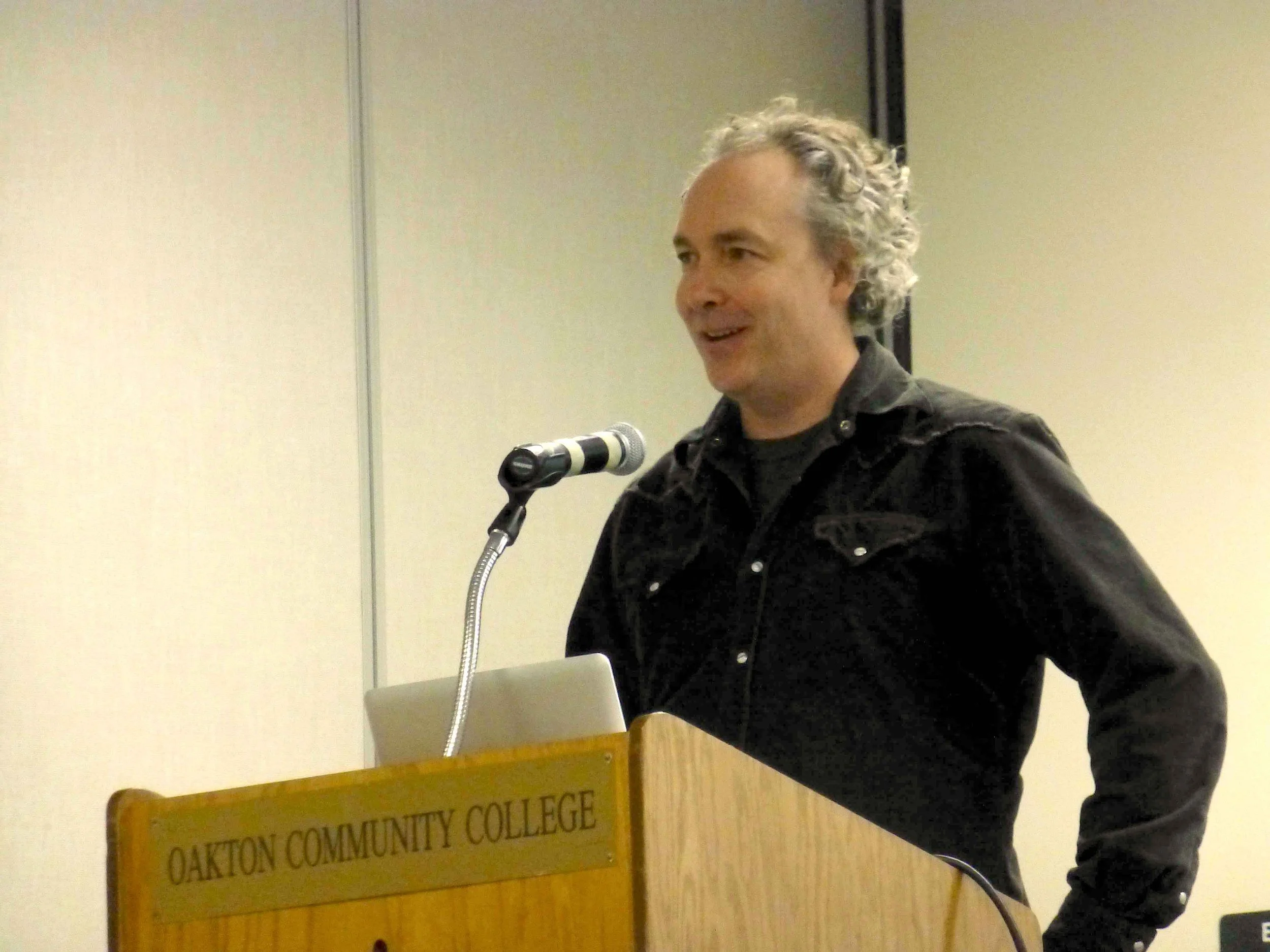
Nicolas Lampert presented at Creating Justice in 2014. This was shortly after the publication of his books, A People’s Art History of the United States. In October 2017, Nicolas Lampert spoke to Mohamed Mehdi at his studio at University of Wisconsin-Milwaukee. Prints Nicolas had made for the recent campaigns of Voces de la Frontera were hanging along with older prints in the studio. Our conversation focused on some of the chapters from his book, and what the historical examples they contain can teach organizers today. We spoke about learning history as a way of developing tactics for political organizing, and the need for a variety of tactics to be understood and deployed for us to achieve meaningful change. In speaking about these historical cases and about his own experience, we returned often to the question of what it means for an artist to be an ally to a movement.
Mohamed Mehdi: There is an aspect of your work that we see in your book A People's Art History of the United States and also in other projects and prints, which is the celebration of movements from history. There's a print that with an image of a panther that says “Learn Black Panther Party History” and another one that says “Learn About Labor History,” and you have prints of socialist and anarchist leaders of the early twentieth century and more recent leaders like Grace Lee Boggs. There is a project commemorating the Commandos in Milwaukee, the NAACP youth wing in the sixties.
These movements have been marginalized in the popular telling of American history, sometimes totally forgotten or misrepresented in terms of what they stood for, can you speak about the importance that you see in calling attention to some of these movements from the past in your work?
Nicolas Lampert: I think it's important for activists today to be knowledgeable about past movements, to study what worked and what didn't. It is important to pay tribute to the courage that these people had and what they stood for. When I try to describe what I do, what my practice is, it's not rooted in a discipline, in art or art history, it’s rooted in social justice and activism and so these are the people to study and to look up to. My primary visual language is print making and artists can visualize these histories tointroduce them to a larger audience. You mentioned the Commandos history. We did a series of murals that's now rooted in the Harambee neighborhood in Milwaukee where a lot of this organizing happened. The murals are without text, they’re an invitation for people to say, “Who are these people, what did they do and why is it relevant today?” And a lot of this also came out my network of the Just Seeds artists.
Josh MacPhee curated the Celebrate People’s History poster series that many of us got our start with, really designing for that, trying to figure out how to visualize and celebrate people’s history as a key part of our visual language.
MM: When you're saying to people, “learn about” this movement, what they did including their mistakes, as an artist do you see your relationship to those movements primarily in terms of honoring them and inspiring others based on that example, or is it as someone saying that we need to learn more about this, the good and the bad? Is there a tension between those goals?
NL: Well I mean when I was younger it was fascinating to learn about these histories and these people because it wasn’t what I was taught growing up. It wasn’t in my high school textbooks, I wasn’t even taught about these histories in college. It was being exposed to presses like AK Press and a lot of the anarchist presses. I was introduced to Howard Zinn's work and Noam Chomsky and others. Of course it was all there, you just had to find it. All of this scholarship opened up a whole new door for me to learn labor history, to learn the history of struggle and organizing, but today I teach those histories as a tool, to understand the tactics of how to organize. The book I wrote, A People's Art History of the United States is a collection of histories, but it is also a collection of tactics, and I think the best compliment I ever get for my book is when people say, “that chapter that I read, it really spoke to me and we've used a certain art tactic in today’s movement.” Some of us started an art affinity group in Milwaukee that was directly influenced by Gran Fury and the AIDS activist movement, ACT UP. Each chapter I wrote in the People’s Art History book I wound up doing three to five thousand pages of research and digging through numerous archives and, you know, you don't see that in a fifteen page essay, but reading all the interviews with Gran Fury members I was just struck. I mean there's certain things that were different in their struggle, but I was also struck by the similar conversations that I have with artists and organizers. Gran Fury started an art affinity group within a movement that had the autonomy and the trust of the movement to do what they wanted and I think that's just a really powerful structure that every grassroots group should have. And so we've been trying to mimic Gran Fury art affinity group structure in Milwaukee. That's one example of how studying the historical past becomes so relevant to today.
MM: I was really interested also in the way that you phrase it so directly in some of your prints, “learn about such and such,” you give an imperative to the viewer that they should take the initiative to learn this. Is that formulation something you drew from somewhere or was it just the most direct way that you could say it?
NL: I have a series of prints that basically says learn about such and such history. It started it with The Black Panther poster and it started because there was a show in Chicago that I believe the Co-Prosperity folks organized. They wanted artists to do riffs on WPA posters (Works Progress Administration), and I remember looking through a book of WPA posters and seeing a Brookfield Zoo poster, in the Chicago area, that had a panther in it – one that looked nearly exactly like the Black Panther Party logo. So, I change the text of the poster to one that encouraged others to learn about the history of the Black Panther Party. It seemed like the obvious thing to do the second I saw the original image. And the thing about these histories is they’re complicated. The text “learn about it” is an invitation to learn about the positives and the negatives of these histories. It asserts that there is power in being informed. It's also an invitation to people of all political backgrounds to study this without me framing it right away in the image. The “learn about” text is a narrative device to bring people in.
MM: A People’s Art History of the United States is an unusual art history book in a lot of different ways. It’s a history book that focuses on these key moments, events and actors and looks at the role that art played in those movements in those moments. And looking at a variety of different kinds of art, not just visual art but also performance, and things that don’t even exist now, like the moving panorama. But you’re not looking at art in general, you're looking specifically at art as it's used in political movements. So the title could be read in different ways. It could be read as “A People's History of Art” or it could be read as “A History of People's Art”. And because it's an unusual type of approach to writing about art, I was wondering if you could tell us a little bit about the impetus behind this work, what led you to do it.
NL: The book specifically looks at movement culture. It looks at the art that's produced by people's struggles and people's movements. I could have written an entire book that looked at the art world's response to social movements. Obviously there’s a deep history of that, if you think of the Vietnam War era, but I wanted to look outside the art world and I wanted to look at the culture that everyday people create inside these movements and when artists join movements or when artists are in solidarity with them. I didn't see a book that put all those histories into one that was accessible to general audience. In the early 2000s I started writing essays and conducting interviews. I worked as a co-editor for a book called Peace Signs: the Anti-war Movement Illustrated that looked at the graphics in the global protest against the Iraq War. At that time, I had just started my college teaching career and as a very young ambitious teacher I tried to go one hundred and ten percent for the students. I assigned Howard Zinn's People's History of the United States as a textbook with the idea that the students would read his book and I would discuss the art that was created during the various time periods. And on a whim I emailed Howard Zinn and asked him if he would come and speak to my class in Milwaukee. I knew that he was speaking often in Madison for at that time in his life he was a columnist for The Progressive. I figured that he was probably flying out of Milwaukee when he traveled to Madison. So, I sent out the invitation and he responded by saying, “I'll be in Wisconsin in two months, I'd love to come to your class.” He said the only hitch is “you have to pick me up in Madison and drive me to Milwaukee and get me to the airport after I give a talk.” And so I picked him up in Madison and we drove the hour and a half drive to Milwaukee. Throughout the drive he didn't want to talk about himself. He wanted to hear about my life and what my interests were and immediately the conversation turned to art. And he told me that his wife was an artist and he was fascinated by the role that arts played in movements, so I started explaining the history of what artists were doing now in the anti-war movement and the research that I'd done about photographers in SNCC (Student Non-Violent Coordinating Committee). He was of course involved in SNCC and he said, “Well, tell you what I'm the editor of a new book series for The New Press. It's spin-off books on my People's History. Why don’t you send me a two-page proposal and I’ll pass it on to the editor.” I emailed it to him and two months later I was asked by The New Press to write the book. So the whole origin of this book came out of an opportunity that Howard Zinn gifted. And, you know, I certainly wouldn't let down one of my heroes so my primary focus for ten years was researching and writing the book. My main editor was from the New Press, but from time to time I’d send drafts to Howard Zinn and get his feedback. In the early research process of this book I quickly concluded that I really wanted to focus on artists outside of the art world, artists that were part of movements. I also made an early decision on the prose. I teach at a working class university. It was really important to me thatI did not write towards a PhD crowd, or even a reader who had taken an art history class or had read an art history book before. I wrote with the assumption that students won’t know these histories. Ask a student today if they know about SNCC and you’ll likely get blank stares. So, part of my role wasinforming a general audience of these histories. The other role was to inform the reader why art and why artists were so important to the tactics of these movements. But the book itself all comes back to Howard Zinn, his influence, and the opportunity that he granted me.
MM: But I guess you deserve some of the credit in the sense that you reached out to someone who was a hero of yours and said, “Why don't you come talk to my class?” without knowing whether he’d accept or not. You found that he gave you this opportunity but I think the first step of reaching out to people who you look up to is also an important part of it.
NL: I mean it's a good life lesson to try to collaborate with those you admire and you share a common interest with. You're always disappointed when you meet someone you admire and they don't live up to your expectations, but that was not the case with Professor Zinn. He was such an incredible person. Years later I was on a panel with his son Jeff Zinn, who’s a playwright, and I told him that story, thinking that his son would be impressed by it. And he's like, “Nicolas I don’t want to burst your bubble but my dad was trying to get everyone to do people’s history.” He said his father wanted as many people as possible to focus their specific discipline towards working for justice. That was part of his legacy.
MM: You mentioned this one main focus of yours which was looking at movement art as opposed to the art world response to politics and activism, but even within that focus there must have been difficult decisions in terms of what to include and what to leave out. How did you make some of those decisions and were there things that, let's say someone said let’s do a brand new edition, was there anything that you had to leave out the first time around that you would now want to include?
NL: It's important to note that the book is not a survey. I wanted to do case studies, and I wanted to move through history chronologically where the reader is being guided through American history. I rejected the idea of a survey because a survey tries to be all encompassing and that's impossible. You're inevitably going to miss and leave out important key struggles and key movements even in that format. So, my focus was on concrete examples and what I tried to do is - I obviously miss a lot of examples - but what I tried to do is make sure that numerous visual art mediums were represented. I could have done the entire book on photographers. Not the entire book, obviously, but from the Civil War on. But I wanted to make sure that a broad range of visual mediums were addressed. For instance there is a chapter on the IWW (the Industrial Workers of the World), and I could have easily focused on graphic artists. Even Joe Hill was a graphic artist and cartoonist. But the book already had a number of chapters that focused on graphic artists and printmakers, so my choice for the IWW chapter was to select an unexpected medium – performance and reenactments – and an example were the history was exceedingly complex, where things didn't work out as expected. That chapter was on the Patterson Pageant (1913) where workers in the strike, the Patterson silk workers, who’d been on strike for over half a year, reenacted their strike as a pageant in New York City during the strike itself. It was a case where the lines of art and life were completely blurred. Striking workers as actors and actresses, and the strike transported to New York City where the performance became part of the strike itself. The goal of the pageant was to raise funds for the families that were on strike and bring more media attention to their struggle. But it backfired. The pageant lost money, it hurt morale, and the art was blamed as one of the key reasons why the strike failed. I analyze in the chapter, and the scholars that I referenced argue, that that wasn’t the case, that industry leaders were not going to cave in to the strikers demands even if the pageant had raised significant funds, especially after the Lawrence textile strike the year prior. IWW organizers like Elizabeth Gurley Flynn made the case that the artists blew it, that the focus on the pageant distracted the striking workers from doing the real work of the strike. That the middle-class artists had little business being involved in a working-class struggle where the lives of recent immigrants to the US were on the line. I, and many other scholars, disagree with that statement, so I made the case that solidarity remains vital today as it did back then. We need artists to be aligned in working-class struggles if they understand their role as allies and if the tactics are solid. The Paterson Pageant becomes a fascinating example of how artists - especially those who come from positions of privilege - collaborate with these movements. The majority of artists that were part of the pageant were based in Greenwich Village in New York City. It was led by John Reed, who was a Harvard graduate, and his task was organizing striking workers to act in the pageant that he wrote. This example from 1913 relates to today and to artists, including myself, who align themselves as allies with the immigrant rights movement and with the struggle of those facing deportation. These families have much more at stake than I ever will and so the question becomes how do you best work in a movement as an ally? How do you listen? How do you step back and check yourself? How do you share your resources and your talents, but do so in a way where you’re not speaking for the movement and you're not bringing harm to the movement? So, I felt that the chapter brought up all these questions and all the conundrums of these alliances and it becomes really relevant to today’s conversation. Had I done a book that was in the survey format I would not have had the page count to go into depth on the Paterson Pageant history. It would have had maybe two paragraphs instead of a fifteen-to-twenty page essay. I needed the space to lay out the history, along with the art. The only downside of the approach was that I had to leave out other histories as I focused on others. It was difficult to leave out the Young Lords or the graphics artists of the farmworkers movement in California. So I certainly missed a lot. But those histories are out there. I kept reminding myself that.
MM: There's a couple things that you mentioned just now with the Patterson example that I wanted to follow up on. One of them was that divide between the Greenwich Village artists and the local workers in the textile industry. In the book you suggest that this divide between the bohemian artists and the working class people is a divide that is equally strong today. Are there ways in which that relationship is different now than it was a hundred years ago, because the nature of the working class has changed so much in the U.S. and also because art is something which has, because of digital media and all sorts of other ways, become a more organic part of people's everyday lives?
NL: Historical examples need to be seen in their context. The proximity of New York City to Patterson, New Jersey put those labor organizers in close proximity with the artists in Greenwich Village. Keep in mind also that the IWW organizers were also outsiders to Patterson. They were brought in mostly from the West, people like Bill Haywood and Elizabeth Gurley Flynn. They were brought in because of their organizing skills and the successes that the IWW had the year prior in Lawrence. Emma Goldman and the Mother Earth publication was also in Greenwich Village at the time and that also introduced artists to activists, along with gatherings hosted by Mabel Dodge. Artists today, and I’m generalizing, lean towards radical politics. But, not as many artists will be as quick to identify as working class, or even as workers. Most artists if you look at their income levels are working class poor, even if they come from middle class backgrounds. Yet, many of these same people don't identify as working-class people. That is a problem. One that reflects the reduced role that unions play not just in the workforce, but in our culture. Union membership is at a seventy-year low, much to the detriment of our society and our democracy. Ask visual artists today if they could ever imagine being unionized. Most would say they couldn’t. One of the key chapters in my book looks at the 1930’s when artists were organized in unions – the Artist’s Union - and when artists did work in solidarity with other union movements and truly identified themselves as organized labor. There werepositives and negatives to this, but it really forged class solidarity and put these artists in the serviceof struggle. So in a roundabout way, I think, if you look at today, the issues I'm addressing are part of artists being allies. It's multi-faceted because it could talk about race, gender and sexuality issues. How does an artist who is white support Black Lives Matter, or how does an artist who is a citizensupport the undocumented and the immigrant rights movement? To me it's all about understanding how to be an ally and how to listen, how to step back. I teach a class right now called “Multicultural America: Art” and the whole focus of the class is to raise the voices of color, artists of color, authors of color, students of color. I told students from day one in a very diverse class that the students of color lead, the rest of us listen, and I think that's a good mindset to go in with whether it is that class or if you’re an artist in a movement. In academia most visual artists get steered towards the art world where the vast majority will never make it. That is just reality. Most visual artists will not make a living, probably never get teaching jobs considering the supply and demand numbers in academia and the abysmal labor conditions in higher education. The design programs steer much of their students to the corporate world, so we're limiting the potential of art for struggle and art for radical change and revolution. We need to change that script. We need more artists to want to dedicate their time and energy to movements and we need more movements to commit themselves to artists. This includes movements finding ways to pay artists and to employ them.
The artist has to also see themselves as one cog in the larger wheel of a movement. It has to be collaborative. At times artists need to recognize that you're there for support. I got hands on experience for this going out to Standing Rock. Support was simply to bring art materials to the Art Tent, and to listen, and to do whatever the Indigenous leadership requested. This is similar to artists who work with the Immokalee Workers, artists like David Solnit who's brought a lot to that movement in terms of the art created, but the primary goal is always to listen, to take directions, and to be part of a collaborative team of many.
MM: When an artist makes that connection with movements is there already an artistic strand within the movement that you are connecting are you the artistic communicators of the work? A lot of movements seem to already have internal artistic practices.
NL: I think it is always specific to each struggle and each movement. The general answer is that these movements already have incredible artists and cultural producers within them and that certainly was the case at Standing Rock. That's the case with the struggles that Honor the Earth, is leading against the pipelines in Minnesota. It's the non-Native artists who need educating that Native artists and designers exist and have long since been working on these struggles. One should also question if a non-Native artist is the best person to design for a Native movement. They do not have the same lived experiences. That said, some movements really value artists of any-and-all backgrounds helping out and view the solidarity between Native and non-Native people as a key tactic.
This took place in aspects of the No DAPL movement and it is taking place also in the No Back 40 campaign on the Michigan-Wisconsin border that's being led by the Menominee. This movement has not garnered national, so everyone who takes part helps to amplify public knowledge. Also, the Menominee Nation has made it clear to non-Native people that they are welcome to support the movement as allies. Community outreach leaders from the Menominee came to Milwaukee, Madison, and other cities and said they needed people to help with the struggle. They reached out to artists and said we need art. The Menominee chose the slogans that they wanted designs for but the feedback I got was that many were appreciative that those from afar were helping out and sending in graphics.
In Milwaukee, myself and a number of my closest collaborators, dedicate a lot of our time to working with Voces de la Frontera and have so for the last decade. Voces is the key immigrant rights group in Milwaukee with nine chapters across the state. The Milwaukee office has a staff of around a dozen people and they are working around the clock on organizing, raising funds to keep the struggles together, helping people who are facing deportation, running citizenship classes, organizing marches, and responding to issues at a moment's notice. That group really values the fact that artists and designers in the city are volunteering their time to help out considering how busy they are with other facets of their work. They value that artists can design the banners, the fliers, and provide other visuals for the movement.
We should never loose site that artists and designers have important skills to offer, skills that some do not have. Not everyone knows how to screenprint for example. Not everyone can quickly shoot and edit a video. As artists we take our direction from the Voces staff. We have a point person in Voces who says “this is what we need, these are the phrases we really want to amplify, these are the type of images…” We run every draft by them, but we have a lot of autonomy because they trust us now. Now we have a greater understanding of what is needed - not as well as the staff does - but since we've been involved for many years, we know what types of images and styles that tend to resonate with Voces and with the community. Now we have an art affinity group within Voces that has over forty artists. A large percent of the group is Latinx artists and part of the tactics right now, or at least my organizing approach, is to make sure that many artistic voices within the group are amplified. In today’s climate there is no shortage of places for artists to get involved, but they need to do so in a way that's smart and well thought out. And that's where history is an important resource to study and to learn from.
MM: Let’s take a couple of other examples from the book of these complicated histories, and you can draw out some of the lessons as you did with the Patterson case. One is the Crow photographer Richard Throssel whose approach you contrast with that of Edward S. Curtis who worked around the same period. You critique Curtis’ representation of Native life, but you also said that in some ways Throssel embraced or encouraged assimilation and criticized traditional ways of life because they might be unhygienic or might lead to other kinds of problems. Another is the case of Henry Box Brown, an enslaved person who mailed himself to freedom in a box, and then used his platform to advocate for abolition. Some people saw his presentations as sensationalist, and he had a rupture with the abolitionist movement in England. Third, Jacob Riis, a photographer for the tenement rights movement ,where you suggest an exploitative relationship with the subjects of his photographs, with these nighttime surprise shoots, flashes going off in people's eyes. Those were all cases of work that has had an impact on future artists and on the causes that they were connected with. And there are very complicated ways in which their work was judged even at the time. It's not even just with hindsight, even at the time people raised these critiques of the work.
NL: The word complicated is key because all these histories are complicated, and that's what makes them fascinating. They're fascinating because you can see, in the case of Riis, two sides of the coin. He did bring a lot of good to a movement. He helped reform abysmal tenant housing conditions. But his tactics were also extremely problematic and that's what makes these histories really important to study. The key is the power dynamics at play – the power dynamics between the artist and the subject. In the case of Jacob Riis, he took photographs of the poor living in crowded and dilapidated tenant housing buildings in New York City. But, he never showed his subjects in positions of power. They were always shown as powerless. Their voice was never amplified. He always took the photographs and framed them around his opinions of what he thought these people needed and he never, for instance, handed the camera over to them and said “What would you photograph?” And that was also akin to the chapter I wrote looking at the photography of the early reservation period. Edward S. Curtis pretty much created the indelible record of that period and Edward S. Curtis refused to show any images that showed native people as happy, content, or as people who are struggling with the forced acculturation and the industrialization of the west. You see no signs of that. No signs of modernization. Basically Curtis showed what he wished to see, which was Native communities untouched by white society. And Richard Throssel – a Cree photographer - becomes really complicated because he presented very similar photographic record in a series that he sold largely to a white audience. He also realized that these were the types of photographs that sold. All artists to a certain extent are shaped by the market pressures that they live by. Throssel took the photographs that he thought the public would want to see, but he also worked for Indian Health Services and took photographs that encouraged Native people to acculturate, to live in essentially European American style houses, to reject Native customs and ceremonies. And of course the great irony of this was he working in concert with colonization. I make the case that he’s also working for survival, that he was looking at health issues, that he was trying to help his community the best way that he could, the best way that he thought he could. He later became a politician in Montana and fought to organize to help Native communities and get more resources. He fought against the big mining interests, so he definitely worked in the realm of an activist. But I think his tactics and his works are open to critique as well. But we have to really understand the time period that he lived in and what he was up against.
I think the encouraging sign today is not necessarily the work of individual artists, but the work of art collectives and artists working in communities, and artists who create platforms that amplify the voices of many. I find the most interesting contemporary art projects are those that allow the platform for others to speak. I like when artists do work that is bigger than themselves. When the individual artist becomes less pronounced. Projects by Hank Willis Thomas and Swoon come to mind. I admire their individual work, but I am much more interested in their collective work. Hank Willis Thomas is part of the Question Bridge project where he and the organizers simply provide a platform for African-American men of multiple generations ask and answer questions through video interviews. Question Bridge has been shown all over the country in places where you don’t expect to see contemporary art – in high school auditoriums, in community centers. The work Swoon did in Haiti with the Konbit Shelter Project is equally transformation. She used herresources and her network to rebuild a community center with sustainable architecture. That is impressive and is arguably her greatest work.
Both of these projects were collective and they reject the lone individual artist narrative. We live in such a capitalistic and individualist society that many artists get so sidetracked that they think what matters is their name and how they market themselves and the opportunities they get for themselves. I think we have to think much more of the collective. How do we empower communities, how do we empower struggle, how do we empower movements, how do we prioritize and reach out in solidarity with those hardest hit in our society like the undocumented, the incarcerated? That's what inspires me. I just finished reading Brian Stevenson's book Just Mercy. He inspires me, that work inspires me, and I think artists could take a lesson from that: how do you empower others. It’s a roundabout answer from talking about Riis or Throssel but I think where they fell short, especially in the case of Riis, is that he didn't ask his subjects on how they wished to be portrayed. He didn't provide a platform to allow people to be portrayed as they wanted to be.
MM: When you suggest that artists put themselves at the service of the community or of a movement and ask, “what do you need” and respond on that basis, what do you make of someone like Henry Box Brown who really did split from the movement and promoted himself and his experience maybe at the expense of others? You could compare him to one of the art stars who wants to make a name for himself, wants to make a lot of money, but you’re sympathetic towards him in the book.
NL: Well again it's such a specific case: Henry Box Brown was enslaved. He was famous for mailing himself to freedom, he mailed himself in a small box that no one ever thought a human could fit into from Richmond to Philadelphia. When he got to the North he found himself at the mercy of the Fugitive Slave Act which meant he could be apprehended and sent back to the South so he escaped to England. There he toured a theatrical show about the horrors of slavery around the British Isles - a moving panorama which was essentially a movie, paintings on large canvas rolls that scrolled in front of the audience that he narrated. He was controversial for different reasons than I mentioned for Riis and Throssel. He was controversial because the abolitionist community thought that the way you presented the abolition struggle was in a straightforward lecture or presentation. There were also power dynamics at play. A lot of the white abolitionists wanted to be the spokespeople and leaders of the abolitionist movement and when you read, when you study the writings of Frederick Douglass, he made the same critique. He grew incredibly frustrated with those in the abolitionist movement, white allies, that they were trying to control the narrative and the movement and Frederick Douglass wanted to speak from his own platform. Henry Box Brown had the same concerns. He wanted to be the narrator for he knew it best. He also wanted to support himself financially while speaking out against the institution of slavery. But he was also an artist. He wanted to speak out it in a theatrical way and the abolitionist movement was more conservative in their approach. They preferred a lecture, not a theatrical performance. However, the greatest critique of him was lobbied at his character. He was purported to be a womanizer, someone who abused substances. People criticized him for allowing the fame to get to his head. He did a panorama that glorified Britain's occupation ofIndia which completely contradicted his commitment to social justice. He also seemed to forget about his family in the US and their whereabouts, so there's a lot of questions lobbied at his character and that he was in it for himself: that he was profiting off the movement. I would argue that his theatrical performances helped bring the anti-slavery message to a larger audience. It was a question of which medium to use. This is not unlike today when a Hollywood film adapts a civil rights movement story.Sometimes a director does the history justice, other times they don’t. I am actually surprised Hollywood has not made a film about Henry Box Brown, especially his story in the British Isles. Henry Box Brown felt that he could reach a larger audience through theatrical performances. He also wanted to chart his own path on his own terms. Artists are always struggling with issues of autonomy and artists want to have artistic license. He was also needed to economically survive. The abolitionist community was not providing enough income to support many of those on the lecture circuit and he wanted to make a living speaking out for what he believed, and all the power to him for making that decision.
MM: Speaking of artistic autonomy, in some ways that gets challenged by putting yourself at the service of a movement, subsuming your own interest to that of this cause or this movement that you're working with, and it made me think about the chapter on W.E.B. Dubois and the anti-lynching movement. Some of the writers of his time like Langston Hughes and Claude McKay you said reacted to Dubois by saying that you're asking us to create propaganda and as artists we don't want to be depicting what we think people should see depicted for some political purpose, we want to depict what our art drives us to depict based on what we experience and see. The term “propaganda” always has a negative connotation. But do you have a more complicated view of what propaganda means in relation to political art?
NL: Well I’d actually like to backtrack and bring up what you brought up about Dubois’ work. Because I think again the point of a People’s Art History of the United States book is the larger questions that are raised from each chapter for how they speak to issues today. It is a history of tactics. We know that it is the multiplicity of tactics and the multiplicity of voices that win struggles. There's no one way of doing things. The civil rights movement had a nonviolent wing, a less radical wing and a very radical wing. It was the combination of all the tactics that made the difference. The suffrage movement had a radical wing and a very cautious wing and they were always at odds against each other. They always criticized each other's tactics, but it was the combination of tactics that worked and that's what we need today. Dubois was one of the great organizers of his time. He was the editor of The Crisis for a quarter of a century, he was an author and a cultural produce. He was also one of the great patrons of the Harlem Renaissance. Yet he was also widely criticized by the same artists and authors that he supported. Dubois was criticized, and should be criticized, for promoting what he considered was the talented tenth: the African-American doctors, college graduates, what he said were the best and brightest. It was an elitist viewpoint, but one that was also tactical to combat white racism. Dubois did not want the public to see images of African-American debauchery or decadence for he felt that would give more ammunition for white America. His logic was don't feed into the stereotypes that they already have about us, and the artists and authors were against that. To them it was censorship. Many of the Harlem Renaissance artists and writers wanted to write and depict what they saw in everyday life. The good and the bad. So, I agree with the artists that Dubois was too rigid. But he felt that being rigid, or being disciplined, was needed. He was waging an all-out campaign against lynching in The Crisis, he was confronting racist laws and a racist system, so it was a question of tactics. Some of the artists were offended by his stance because they also felt that their tactics were equally effective in combating racism. But DuBois felt that artists weren’t harnessing their power for the struggle and were too individualistic in their approach, and you see that today. But you can also see how the artists and authors were also effective, so again it was the multiplicity of approaches that worked.
MM: Looking at some of these tactics closer to the present time, you write about creating culture and art and the role that it plays in creating culture that represents what the change is we’re looking forward to. Like with the Black Panther Party, for example, and Emory Douglas. Some of his work tried to create images that may not reflect current reality of his time, but that reflects reality as he imagined it should be. So it helps to create a cultural grounding for the work that is to be done, it shifts our understanding of who we are and who we should be. And I am curious what you think about how the role of images in accomplishing that may be different now. What do you think is the effect of the ubiquity of images on the ability of an artist to make that type of impact with a particular vision?
NL: I think it has a lot to do with your audience and how you disseminate images. There are multiple venues for images today and I think social media is changing the way artists design. A lot of artists are designing to reach people with extremely short attention spans or to get a message out that will be seen at the speed of light, basically, when people are scrolling through their social media feed. I even know artists who are saying they design their graphics hoping that people adopt it as their profile picture in social media and that's something that John Heartfield wasn’t thinking about he was doing his graphic campaign in the 1930s. So I think artists need to be smart about how they disseminate their work and there's multiple ways. I don't necessarily think it dilutes it. I mean obviously it's a deeper conversation about how we are inundated with images and technology and how that impacts us. Right now I would make the case that the Trump administration is trying to inundate us with a perpetual crisis, that they are bombarding us with one crisis after another, so that society’s overwhelmed and we can't organize and fight back effectively. I would also make the case that the decimation of the labor movement over the last forty years has played a great role in that. Regarding Emory Douglas, we can’t consider his work without considering the fact that it was in service to the Black Panther Party. When I look at all the artists I wrote about in the book, one that spans over 250 years, the one truly revolutionary artist that stands out is Douglas. As a revolutionary artist he put his art in the service of revolution. He was a Black Panther Party artist. He was a key member of the leadership of that party and his art was in service to the politics. I traced in the chapter how his art changed as the politics of the party changed. His art changed to really focus on the community support programs when the politics changed. But there's very few artists that join revolutionary organizations the way that Douglas did and put their art in service to them and so we can’t understand his art without understanding the politics and the history of the Black Panther Party at that time. It's even odd to see his art now in museums now. The work is still radical and revolutionary, but the focus for many viewers today is likely on the images themselves which removes it from the time period, the politics and the struggle of why the art was first created. The majority of his images were created for the publication The Black Panther Paper so we also have to understand his art as part of the Black Panther Party journalism and media campaign. Douglas still fights to this very moment. Much of his art is aligned with the Zapatistas. He works is solidarity with the Zapatistas. And it make sense. They were, they are, an armed struggle and the alliances and similarities are so obvious, but very few artists dedicate themselves in such a politically intense way as Douglas does. Very few artists commit themselves to revolutionary thinking and action. Think about the sacrifices most artists make and then look at that the sacrifices he made. He risked being killed, imprisoned, or seeking exile as most Panther leaders did. A lot of the Panthers leaders were killed by the government, by the police, by COINTELPRO. But that same system couldn't stop the culture as easily, and that's one lesson that Douglas teaches us. I also make the case that a lot of these images advocated for what the Panthers wished to see in the black community, that the Panthers wished to see the community be far more revolutionary and radical than they actually were. The Panthers were akin to other revolutionary movements taking place in the world - in Central America and Africa and Southeast Asia. They were trying to advocate that the black community adopt similar revolutionary tactics. Yet they were so much more radical than those around them, and Douglas was trying to visualize what a revolutionary urban black community would look like. A lot of the images were fictitious. They were showing the community in armed struggle where it was really a small number of the community, the Black Panthers, who were. I tried to make the case, is this real or imagined violence? In truth it was both. Some of the Panthers fought gun battles with the police much to their detriment because it led to their death, jail sentences, or having to exile the country, but at the same time who am I to critique Emory Douglas and the Black Panthers? Those are the tactics they felt they needed. They were responding to their time and place. It's easy to look back in hindsight to make a critique, but how did they know what was going to work and not work at the moment? They felt that that was a necessary tactic. They were also responding to the shortcomings of the mainstream civil rights movement and the lack of real change in the US. That was for me a really difficult chapter to write because it wasn't my place to outright critique what the Panthers felt needed to happen. And that goes back to what you said at the start of this interview about you highlighting that image that simply says Learn about Black Panther Party History. Learn about different viewpoints.
MM: You've talked about your work with the Just Seeds Artists Cooperative and other organizations as a print maker. Can you tell us about Just Seeds as an organization, how it came about, and the importance of printmaking as a political artistic practice?
NL: Well Just Seeds was formed by Josh MacPhee in Chicago in the mid 1990s, and this is pre-internet. It was basically a mail order catalog where he wanted to disseminate his art and the art of his friends through a larger network. He want to get social justice prints out to a larger audience. He also wanted to distribute the series that he curated, “Celebrate People’s History” but at the same time he was forming a network. So when Josh decided to turn it into a collective which happened in the mid 2000s he invited like-minded artists that he had come to know across the country and he invited us all to turn his project into a worker-run print cooperative. We now have thirty artists and we’re a decentralized print cooperative with artists all over North America, including Mexico and Canada. By being decentralized it allows us to really focus in on the regions of North America that we live in, but it also allows us to come together. Just Seeds has multiple platforms that we’re working on. First and foremost, people see us through the web, through our site, and they see the prints we put up and they see a blog on activist art. About once a year we do a large group project – often a print portfolio - where we essentially put ourselves in service to a movement. We have done past portfolio project on the prison abolitionist movement with Critical Resistance, we've done a number of projects with Veterans Against the War, largely due to our collaboration with Aaron Hughes. Now Aaron Hughes is part of Just Seeds. We’re doing a new print project for the Poor People's Campaign that will be released in early 2018. So Just Seeds is complicated in that manner, it threads the line of a lot of what we're talking about in this interview, it really honors the individual, yet we do a lot of projects that are in service of movements. For instance, there's no collective voice of Just Seeds. We've been asked before, will Just Seeds make a statement on this, or will Just Seeds sign a statement and stand behind this, or what does Just Seeds think about this, and our answer is always, “ask each individual.” It came to a head once when Favianna Rodriguez made a print celebrating Sonia Sotomayor for Supreme Court. She was celebrating that the Supreme Court nominee was Latina and this was, to many Latinos, extremely prideful to have a Latina woman as a Supreme Court justice. And some people criticized Just Seeds, saying, we thought you were anarchists, why are you celebrating this?And our response was, we don’t all think alike. We’re not all anarchists. There's no collective voice on this issue, ask Favi about her image. At the same time, I thought we should also be supportive ofFavi and her right to post any image of her choice. As a collective we should support one another.
In truth, Just Seeds is not a collective, it is a cooperative – it is a cooperative of different artists andthe many networks that they work with. I think a good example of this is Chip Thomas. He organizes the Painted Desert Project on the Navajo Nation where he lives. He's part of a global street art network so he introduces his network to the Just Seeds network and vice versa. It is a case where the cooperative is a sum of all its parts and all the individual interests of its members. I think Just Seeds keeps on evolving but I think its history is really defined and written by what each of the thirty members are doing and I think it's a really interesting example of how a decentralized group of artists can operate. But it comes with a lot of inherent problems. We barely get a chance to all see each other so that can make some feel disconnected. Or when we did meet up it was in the context of long meetings on how to run a collective that really seemed to drain the energy of the group. And now when we do meet up, we do creative projects, things that we really enjoy, so that seemed to solve that issue, while likely creating others. Just Seeds also lacked diversity when it began. Josh immediately brought in fifteen people, many of whom were white artists. Now Just Seeds is more diverse, but it still has a long way to go. This is key because it underlies who feels welcome and who doesn’t. It just reinstates that collective work is difficult and ensuring the health of the cooperative is not easy. I think Just Seeds is in a pretty good place now and will be because it is important to many of the people in it. Also, we know that the work is important to our audience. The public persona of Just Seeds simply sees all these images coming out every other day. I keep reminding myself that we inspire people with our art. We amplify messages and that's why many of us gravitated to printmaking because of the way it's disseminated and how cost effective it is. We sell most of our prints for twenty to thirty dollars because we want to make our art affordable to working class people.And the medium itself has such a long history of being utilized for social justice and for organizing.
MM: The material process of print making as you mentioned has these benefits in terms of distribution and cost. Because of these benefits it has been a part of political movements for a really long time. So when you inherit and you build on that material history does that also bring with it a kind of aesthetic history that's part of the work when you’re doing printmaking?
NL: Most definitely. The Tallerde Gráfica Popular (Workshop of Popular Graphic Art, TGP) in Mexico City has definitely influenced many in the group. Music has too. A lot of the artists in Just Seeds also came out of the DIY punk rock community, which really has the ethics of you do everything yourself, you organize, you tie your work to political struggles, you start your own cooperatives. A lot of us also have other jobs, barely any of us live as full-time artists, Chip Thomasis a doctor, Alec Dunn is a nurse, Bec Young is becoming a speech therapist. A number of us are teachers and so our first love, for many of us, is art, and it's great that we found each other and we have this network.
We amplify other artists and their voice on our platform, but many of us in the cooperative over extend ourselves with work and other projects. Many of us work on local campaigns in our cities, our home communities, and that's where the blog becomes so important. Much of what I do now is art builds, organize art builds, specifically for teachers' unions, or for Voces that’ll have four or five hundred people participating and it doesn't matter to me if even one of my images is used in it or not. In many cases I’m organizing the production of other peoples’ images. But I know those art builds have tremendous power and use for movements. And another example of local work is Shaun Slifer who helps run the Just Seeds store in Pittsburgh, but he also helped create a mining museum in West Virginia about the miners’ struggle, which is just one of the most incredible museums that exists anywhere in the world. That is the kind of the spirit that comes out of the cooperative. People are just fearless and do thesereally interesting projects, many of which you don't see when you just look at the prints. Just recently Thea Gahr and Chip Thomas were on the US Mexico border where they ran a printmaking workshop where people were handing prints back and forth between the border wall. There's a photo of a hand reaching through the border wall from the Mexican side passing over a print. To me that's what it's all about. It’s not just about the art that the artists make,but it's about the people behind it and what drives them to create this work.
MM: Looking at some of the powerful prints you’ve created, it's almost like a compass in some ways. It provides you with the support for your values, for what you care about, and they can feed your political imagination with an image or a simple text. And there is also this level of playfulness that I want to end by having you say something about. For example, you use these American symbols like the milk carton with the missing notice to talk about you the missing people from communities who have been incarcerated, or the no smoking campaign to talk about coal generated power, the customs agent symbol with the Imagine No Borders text. Can you say something about the role of playfulness and humor in this kind of work?
NL: These are serious issues - life and death struggles – so you need to invite your audience into the conversation. Use recognizable symbols. Some of the prints have elements of humor. Graphics also have their own history, their own trajectory. I have made some designs that I had thought were going to be really powerful and useful to a struggle or a movement and the graphics never went anywhere.Just duds. And then other graphics just take off whether this is by happenstance, timing, or how others promote the image is hard to say. So over time one starts to reflect on which graphics work and which graphics do not. I tend to think the graphics that are positive make the greatest impact, the ones that people want to see, the ones that speak of affirmation, that speak of struggle and dignity. A lot of people for instance don't want to see an image of the horrors of war on their wall. Instead they want to see an image that celebrates a victory, or an image that speaks to their values. Images that are uplifting. I also noticed that the images that showcase people and celebrate people tend to be the ones that really resonate with our audience. And that has an influence on how one designs because you want to reach an audience and you want your work to be impactful. So, I think a lot of us in the group are conscious of this and our work starts to become influenced by our audience. That said, you never know who will see it and how it will impact them. You only hope that it is a positive force for change.